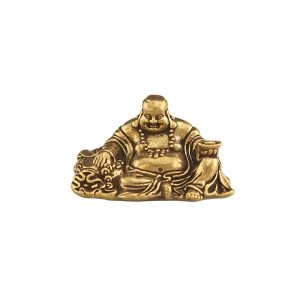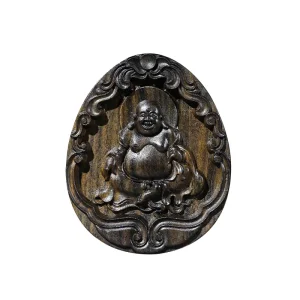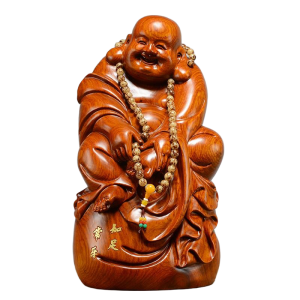
Standing in the courtyard of a temple in East Asia, the contrast is jarring. Inside the main hall sits Siddhartha Gautama, the historical Buddha—gaunt, serene, eyes half-closed in deep meditation, embodying the ascetic discipline of ancient India. But just outside, or often right at the entrance, sits a completely different figure. He is loud. He is fat. His robe is falling off his shoulder to reveal a chest that hasn’t seen a gym in decades. This is Budai. And unlike the silent Prince Siddhartha, Budai is laughing.
For years, I mistook this figure for a “corrupted” or commercialized version of the Buddha. I was wrong. The story of Budai isn’t a corruption; it is a revolution.
To understand him, ignore the golden statues in souvenir shops and go back to the Jingde Record of the Transmission of the Lamp, a text compiled in 1004 AD. It introduces us to a monk named Qieci from Fenghua, Zhejiang. He was hardly a model Buddhist. He roamed the muddy streets of the Liang Dynasty—a brutal period of civil war—begging for food. He ate meat. He drank wine. He broke every rule in the book—scandals that should have seen him kicked out of any respectable monastery. Yet, the locals didn’t shun him. They loved him.
He carried a hemp sack (budai) everywhere. Folklore claims it was a magical paradox: never full no matter how much he stuffed in, yet never empty when he needed to give. Inside, you wouldn’t find gold coins. You’d find leftovers, broken toys, and rubbish he picked up from the road. When children asked him what was in it, he would reach in and hand them a piece of dried fruit or a trinket. This wasn’t just charity; it was a sermon without words.
Qieci didn’t just break social norms; he dismantled the theology of his time. Before him, Maitreya (the future Buddha) was depicted as a regal, heavenly being waiting in a distant paradise called Tushita. But in 917 AD, sitting on a rock at Yuelin Temple, Qieci whispered a death verse that collapsed the distance between the sacred and the mundane:
“Maitreya, true Maitreya, manifests in billions of forms. Constantly he shows himself to people of the time, yet they do not recognize him.”
With that single breath, the “Master Dingying” (as he was later posthumously titled) claimed to be the savior. He pulled the divine down from the heavens and placed it in the body of a wandering beggar. He showed that enlightenment wasn’t about sitting perfectly still; it was about wading into the mess of the world and finding joy right there, amidst the dirt.
This context changes how we see his famous belly. In the West, we often view the stomach as a sign of gluttony. In the Chan tradition, that massive paunch represents du-liang—capacity. It is a spiritual container large enough to swallow the insults, the bad luck, and the suffering of the era without complaint. He digests the world’s bitterness and turns it into a laugh. He isn’t just happy. He is free.
Modern commercialism has unfortunately flattened him into a mere “wealth magnet.” We are told to rub his belly for money. But if you visit Mount Xuedou today, the atmosphere feels different. You see pilgrims touching the statue not with the desperate look of someone wanting to win the lottery, but with a sigh of relief.
So, next time you see that gold-painted statue in a noisy airport restaurant, look past the grin to the sack on his back. It’s a reminder that we’re all carrying too much. Maybe the reason he’s laughing so hard is that he’s the only one in the room who realized he could just… let go.