
A few years ago, a young marketing executive in New York found herself sitting in a crowded subway car, overwhelmed by deadlines, phone buzzing in her pocket, and the low thrum of exhaustion that had become normal. A friend had suggested she try “mindfulness,” but the word sounded vague, like another wellness trend that would fade after a season. Still, she downloaded a meditation app. On that noisy train, she put in her earbuds, followed a simple instruction to notice her breath, and felt—just for a few moments—that the world wasn’t pressing down quite as heavily.
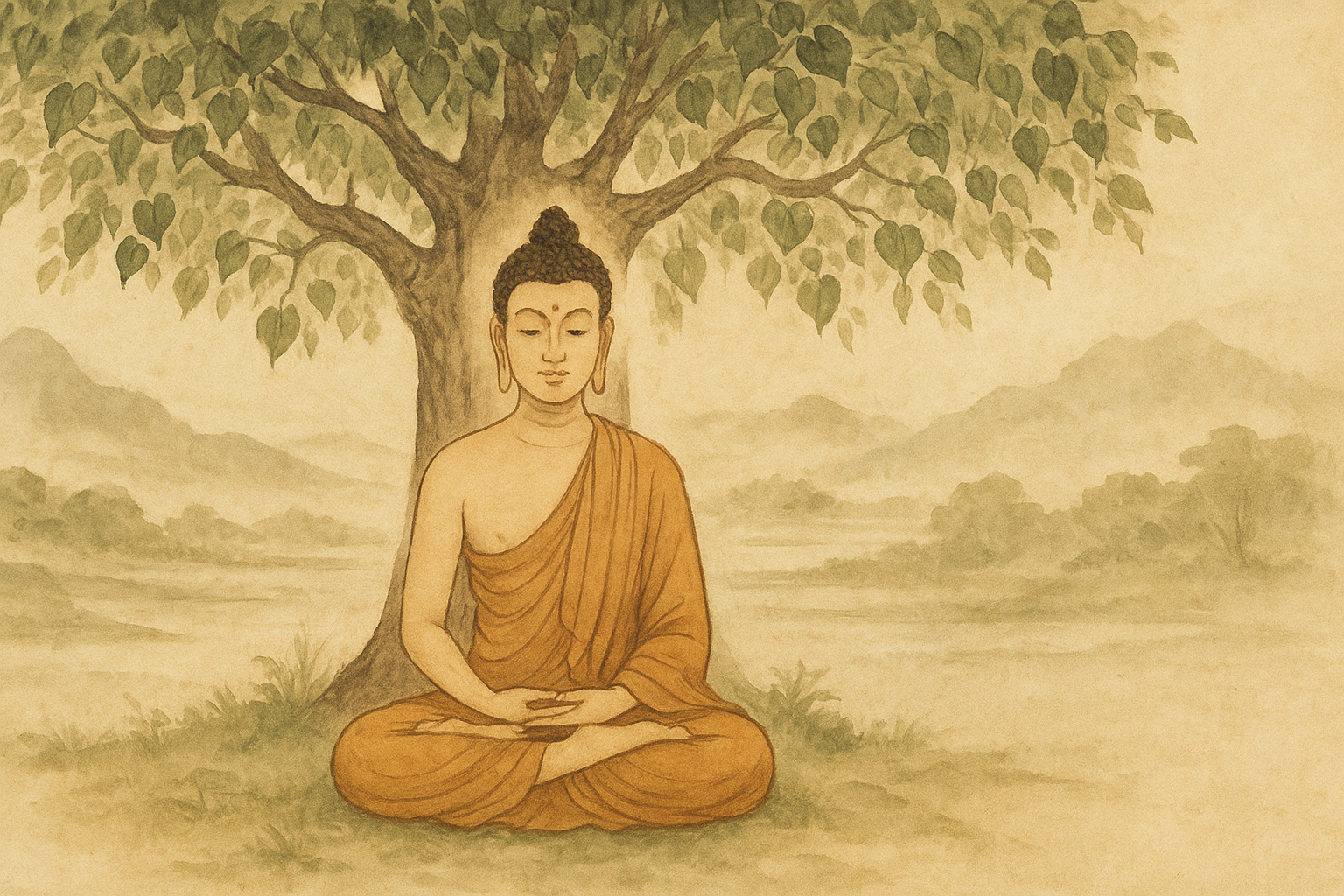
That scene could have happened anywhere: in London, Berlin, Los Angeles. What’s striking is how ordinary it feels, and yet how much it echoes something very old. The practice she stumbled into is part of a tradition that began more than two thousand years ago under a tree in northern India, when a man named Siddhartha Gautama sat still and faced the restless movements of his own mind. Today he is known as the Buddha, and his insights continue to find new life in moments like that subway ride.
The endurance of this tradition is not due to mystery or ritual alone. At its core is a very simple act: noticing life as it is. The Buddha never promised a way to erase suffering overnight. Instead, he suggested a different posture toward it. He saw that much of human struggle arises not just from pain itself but from the way we cling, resist, or run from it. His experiment was radical in its simplicity: sit still, breathe, watch thoughts and feelings appear and fade, and in that clear seeing, discover a little more freedom.
For centuries, these practices remained largely within monastic settings in Asia. But as Buddhist ideas traveled along trade routes and later through migration, they encountered new audiences. By the twentieth century, Western philosophers, psychologists, and poets were already paying attention. When the Vietnamese monk Thích Nhất Hạnh introduced “mindfulness” to American audiences in the 1960s, he described it not as an exotic ritual but as a way of being present while washing dishes, walking, or listening to a loved one. His words struck a chord in a culture hungry for authenticity in daily life.
Modern science soon lent support. Clinical studies showed that mindfulness-based stress reduction could lower anxiety, improve sleep, and even reshape patterns in the brain. Neuroscientists observed how regular meditation quieted regions associated with fear and heightened activity in areas linked to compassion. What once sounded mystical became something measurable, and hospitals began to recommend mindfulness to patients. Schools and companies followed. A quiet practice that once belonged to monks in saffron robes now had a place in classrooms and boardrooms.
But if you step back from the research papers, the essence remains disarmingly human. Anyone who has ever paused in the middle of a chaotic day and simply taken a slow breath has tasted it. Mindfulness is not about escaping into a trance or rejecting the world; it is about inhabiting it more fully. A parent overwhelmed by the noise of children, a nurse rushing between patients, a student facing exam stress—all can touch the same stillness the Buddha described, if only for a moment.
This accessibility explains why Buddhism today appeals to so many who do not see themselves as religious. In the West, belief systems are often tied to identity, and religion can feel divisive. Yet Buddhism enters differently: less as a creed to adopt than as an invitation to experiment. You do not need to accept metaphysical claims to notice your own breath. You do not need to believe in reincarnation to feel calmer after ten minutes of sitting quietly. What matters is the practice, and the experience that follows.
Consider again the young executive on the subway. Over time, she began practicing more regularly, not out of devotion to a faith, but because it helped her sleep and face her work with less anxiety. She later learned about the Buddha’s life and found comfort in the fact that his story began not with perfection but with confusion. He, too, wrestled with dissatisfaction in the midst of luxury. He, too, asked what it meant to live well. In that recognition, the gap between ancient India and modern Manhattan suddenly seemed smaller.
The thread running through all of this is surprisingly simple. When the Buddha spoke about suffering, he wasn’t addressing some ancient problem that belongs only to history. He was describing the same restlessness that shows up today in the form of burnout, endless emails, or the late-night habit of scrolling long past the point of exhaustion. His answer wasn’t a set of dogmas to accept but a set of practices to try. Sit down. Breathe. Pay attention. See what happens. That quiet invitation has outlived empires and still makes sense in an office cubicle or on a crowded train.
In our age of constant distraction, even a moment of attention can feel radical. To really notice the taste of morning coffee, or the sound of rain against a window, is to step for a moment outside the push and pull of deadlines and notifications. Life’s pressures don’t vanish, but they take on a different shape. Stress stops feeling like an iron wall and becomes something more like passing weather.
That invitation is still there for anyone who wants it. You don’t need special training or belief—just the willingness to pause. The miracle, if there is one, lies in how ordinary it is: a single breath, a small act of presence, repeated until it changes the way the world feels. More than two thousand years have passed since a man sat beneath a tree in northern India and faced his own restless mind. Yet the possibility he discovered—a little more freedom, a little more ease—waits in every breath we take today.
