
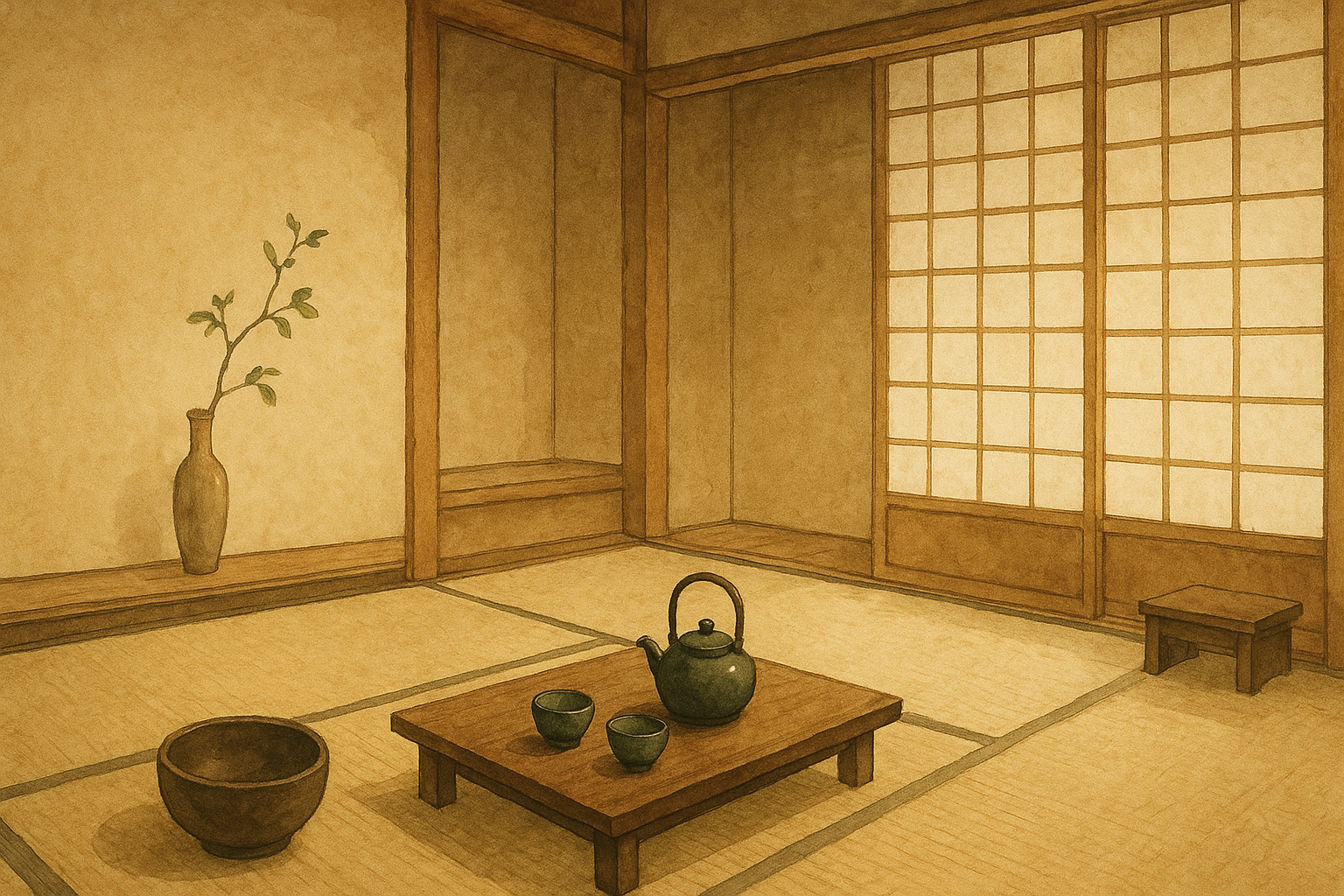
In a small tea room in Kyoto, the air is still. Not silent—there’s the faint hiss of water heating over charcoal, the soft scrape of a bamboo whisk against ceramic—but still in the way a held breath is still. The room is made of unfinished wood and washi paper, its floor covered in tatami that has yellowed slightly at the edges. There’s no decoration. No clock. The only object placed with intention is a scroll in the tokonoma, the alcove where things are meant to be seen but not stared at. Today it reads: 一期一会—ichigo ichie, “one time, one meeting.” A reminder that this moment will not come again.
The tea ceremony, or chanoyu, is often described in the West as an aesthetic practice—an exercise in harmony, precision, in the beauty of a bowl’s curve or the texture of powdered matcha. But that’s a surface reading. To sit through a full chaji, a four-hour tea gathering, is to undergo a slow dismantling of habit. It’s not about drinking tea. It’s about learning how not to reach for the next thing.
The Monk, the Merchant, and the Making of a Mindful Ritual
The ritual was formalized in the 16th century by Sen no Rikyū, a merchant’s son who became the most influential tea master in Japanese history. He didn’t invent the ceremony, but he refined it into a spiritual discipline shaped by Zen. Rikyū served warlords—men who carried swords and ordered executions—but his tea room was a space where status dissolved. The nijiriguchi, the crawl-in entrance, was designed so that even a shogun had to bow low to enter. No one stood above anyone else here. The tea was the same for all. The silence was the same.
Rikyū studied under Zen monks and absorbed their teachings on non-attachment and direct experience. He stripped the tea room of opulence, favoring rustic wabi aesthetics—cracked bowls, asymmetrical vases, humble materials. This wasn’t minimalism as lifestyle design. It was a rejection of permanence. A chipped bowl wasn’t hiding its history; it revealed it. In that imperfection, there was truth.
Every Movement Is a Meditation
The preparation follows a sequence so precise it borders on choreography. The host cleans each utensil in front of the guests—not for hygiene, but as a form of meditation. The movements are deliberate, unhurried. A cloth is folded a certain way. A ladle is held at a specific angle. Water is transferred from kettle to bowl with a rhythm that mimics breath. There’s no room for improvisation. And yet, within this rigidity, there’s an openness—each gesture is meant to be fully inhabited, not performed.
This is where the Buddhist undercurrent becomes visible. The ceremony is not symbolic in the way Western rituals often are—where a wafer “represents” sacrifice, where wine “stands for” blood. In chanoyu, the act is the meaning. Cleaning the bowl isn’t a metaphor for purification. It is purification. Drinking the tea isn’t a reminder to be present. It forces presence. The bitterness of the matcha on the tongue, the warmth of the bowl in the palms, the slight grit of the powder between the teeth—these are not distractions from meditation. They are the meditation.
The Four Words That Define a Way of Being
The philosophy behind the practice is condensed into four principles: wa (harmony), kei (respect), sei (purity), and jaku (tranquility). But these aren’t goals. They’re conditions created by the process itself. Harmony arises when host and guest stop performing for each other. Respect emerges when hierarchy is suspended. Purity isn’t cleanliness—it’s the absence of pretense. And tranquility? That comes only after effort. Not before.
These ideas didn’t emerge from scripture alone. They were shaped by the historical moment—Japan’s Sengoku period, an age of war and uncertainty. In such times, the tea room became a sanctuary not through escapism, but through radical attention. To focus on the temperature of water, the sound of the whisk, the way light falls on a tatami mat—this was an act of resistance against chaos.
Why the West Keeps Misunderstanding Mindfulness
Western mindfulness apps now coach users to “notice the temperature of your coffee,” to “feel the cup in your hands.” These instructions echo teachings that were embedded in Japanese tea culture centuries ago. But there’s a difference: in the app, the moment is a tool. In the tea room, the moment is the entire structure.
Modern wellness culture often treats mindfulness as a productivity hack—a way to reduce stress so you can return to work more efficiently. But chanoyu was never meant to optimize life. It was meant to interrupt it. There is no “after” in the ritual. No return to business as usual. The point isn’t to carry the calm into the office. It’s to question why the office demands such a price.
At the end of the gathering, the host cleans the utensils again, in full view. The bowl is wiped, the whisk dried, the cloth folded back into its original shape. Nothing is left disturbed. The guests bow. The host bows. No one says “thank you” aloud. It’s understood.
This final act isn’t just about order. It’s a reflection of mujō, the Buddhist concept of impermanence. Everything that was brought into the room—the water, the heat, the shared silence—has served its purpose and now returns to stillness. There is no archive. No photo. No review. Just the knowledge that it happened.
Outside, the city continues. Trains run late. Emails pile up. But inside, for a brief stretch, time didn’t accelerate. It wasn’t filled. It was attended to.
And that, perhaps, is the most radical gesture of all.
