
Introduction: The Man with the Bottomless Bag
We have all seen him. He is the chubby, bald deity perched on the counter of your favorite Chinese takeout spot or tucking into the greenery of a Zen garden. Most of us instinctively reach out to rub his exposed belly, hoping to coax a little luck out of the universe. But there is more to this figure than just a lucky touch. To fully understand the monk behind the smile, we must examine the most mysterious object he carries: the unassuming, rumpled sack slung over his shoulder.
It looks like a hobo’s bundle. It looks like laundry. But this isn’t luggage. This figure is Budai(or Hotei in Japanese), a name that literally translates to “Cloth Sack.” He is defined not by his divinity, but by his burden.
To the untrained eye, it’s just a bag. But ask a Feng Shui master, and they see a Cornucopiaof infinite wealth. Ask a Zen priest, and they see a vessel of emptiness. For the Western collector or spiritual seeker, the question remains: What is actually inside that sack?
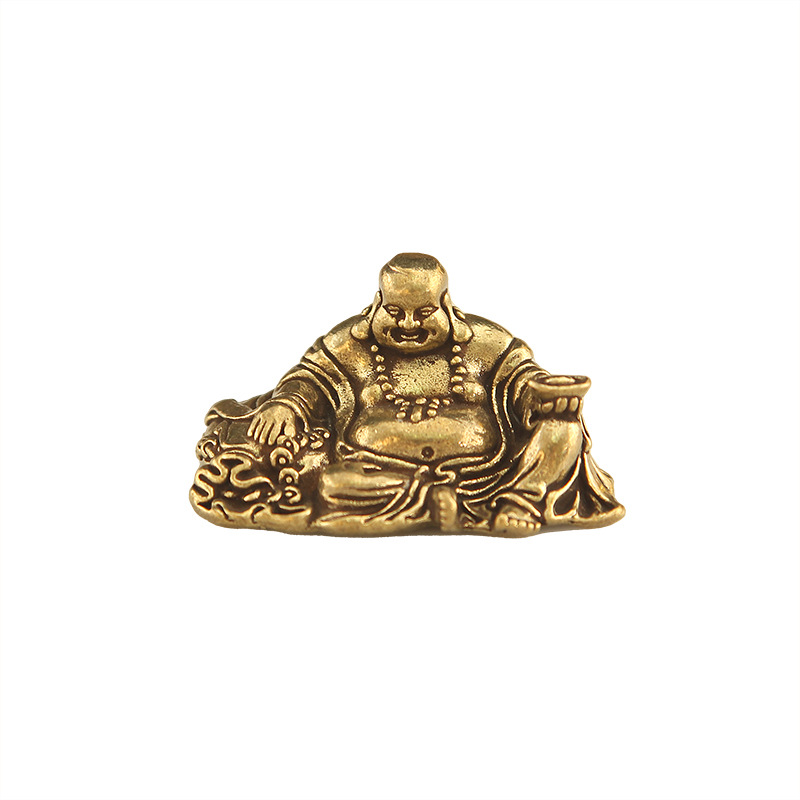
Brass Laughing Buddha Statue
-
Compact Dimensions: Approximately 4.1 cm (1.6 inches) in length and 2.1 cm (0.8 inches) in height, making it a versatile decorative piece.
-
Intricate Brass Work: A detailed sculpture crafted from solid brass, featuring the Laughing Buddha’s iconic joyful expression and traditional robes.
-
Symbol of Positivity: The Laughing Buddha is widely regarded as a symbol of happiness, contentment, and prosperity.
1. The Literal Interpretation: A Wanderer’s Modest Treasures
To understand the bag, we must look at the legend of the monk himself. Budai was modeled after a wandering Zen monk from the 10th century. Unlike traditional monks who stayed in temples, he was a vagabond.
On a literal level, folklore tells us the bag contained his few meager worldly possessions. However, the bag was also his pantry. Legend says the Laughing Buddha would travel from village to village. He was famously generous, especially with children.
When we ask what is in the Laughing Buddha’s bag, the most heartwarming answer is: sweets, toys, and food for children.
He was known to reach into his sack and pull out rice plants, candy, or small trinkets to distribute to the village kids who followed him. In this sense, the sack represents the joy of charity and the simplicity of sharing. It wasn’t about expensive gifts; it was about the abundance of spirit. For Western art lovers, this aligns him closely with the archetype of Saint Nicholas—a figure whose bag is a vessel of pure generosity.
2. The Feng Shui Perspective: An Inexhaustible Cornucopia
While the historical monk carried rice and sweets, the Laughing Buddha statues found in modern homes carry something heavier and shinier. In the realm of Feng Shui, the sack has been reimagined as the ultimate symbol of abundance.
For homeowners looking to attract wealth and prosperity, the sack is not full of leftovers—it is a “bottomless vessel” of riches. In many statue designs, the bag is depicted as bulging and heavy. If you were to untie the knot, Feng Shui lore suggests that gold ingots, precious gemstones, and ancient coins would spill out.
This turns the Laughing Buddha into a powerful wealth cure. The bag is believed to be magical; no matter how much he gives away, the bag never empties. It represents a continuous flow of financial energy. Unlike a bank account that depletes as you spend, the Laughing Buddha’s sack represents the concept of infinite resourcefulness.
When placing a statue in your home—specifically in the wealth corner (the southeast sector)—the bag is the focal point. It symbolizes that the household will never run out of resources, be it food, money, or opportunity.
3. The Spiritual Alchemist: Carrying Your Burdens
This is the interpretation that resonates most deeply with modern Western audiences facing high-stress lifestyles. If the bag can hold infinite things, perhaps it isn’t just for carrying items to give to people; perhaps it is for carrying things away.
There is a profound philosophical view that the Laughing Buddha’s bag is used to collect human suffering. As he wanders through the world, he doesn’t just hand out sweets; he gathers the sadness, woes, and troubles of the people he encounters.
When you look at a statue of Hotei laughing uproariously, he isn’t laughing because he is ignorant of the world’s pain. He is laughing because he has gathered everyone’s problems into his sack and transmuted them. He performs a spiritual alchemy, stuffing worries, stress, and bad luck into his “Cloth Sack” so that you don’t have to carry them anymore.
This perspective makes the Laughing Buddha a symbol of mental health and mindfulnessrather than just financial gain. For the tired executive or the stressed parent, the sack is a container for their anxieties. He carries the heavy load so you can walk lightly.
4. The Zen Paradox: The Bag of “Nothing”
Finally, we arrive at the most esoteric explanation, often appreciated by serious collectors and students of Zen Buddhism.
One famous story involves a monk asking Budai, “What is the meaning of Zen?”
Budai immediately dropped his sack to the ground.
The monk then asked, “How does one realize Zen?”
Budai silently picked up the sack, threw it over his shoulder, and walked away laughing.
In this context, the bag contains Emptiness (or Śūnyatā). In Eastern philosophy, emptiness does not mean a lack of things; it means a space where infinite possibilities exist. The bag represents the universe itself. It is huge, billowing, and shapeless because it contains the vastness of the sky and the earth.
He demonstrates that to be enlightened, one must first learn to “put it down” (let go of attachments, ego, and baggage). But one cannot stay there; one must eventually “pick it up” again and continue to live in the world, serving others with a light heart.
The bag is paradoxically full of everything (the universe) and full of nothing (detachment).
Conclusion: Why the Sack Matters to You
When choosing a Laughing Buddha statue for your home or office, the sack is not a minor detail—it is the story.
Depending on what you need in your life, the contents of the bag change:
- Do you need more joy? He is carrying sweets to remind you of childhood innocence.
- Do you seek financial freedom? He is carrying gold ingots that will never run out.
- Are you burdened by stress? He is waiting to put your woes into his sack and seal them away.
Ultimately, the Laughing Buddha’s sack is a mirror. It contains whatever you are seeking. By keeping his image near, you are invited to embrace the spirit of the “Cloth Sack Monk”: to give generously, to accept abundance, and to walk through life’s challenges with a smile, knowing that your burdens can always be carried by a power greater than yourself.
