
If you have ever walked into a traditional Cantonese restaurant in London, a police station in Hong Kong, or an antique shop in San Francisco, you have likely met him already. He is unmistakable: a figure of imposing stature, sporting a magnificent, flowing beard, his skin flushed a deep, vibrant red. Often, he is depicted reading a Confucian classic or clutching a formidable polearm.
This is Guan Yu. To the uninitiated Western eye, he is a striking aesthetic figure. To the student of East Asian history, he is a phenomenon. Born in the waning days of the Eastern Han Dynasty, Guan Yu lived as a mortal general but died to become a deity. In the centuries following his death in 220 AD, he was canonized by emperors, revered by monks, and worshipped by secret societies.
As we dissect the aspect of Guan Yu that allows him to straddle the line between bloody history and divine benevolence, we must distinguish the man from the myth, a task that has occupied historians for nearly two millennia.
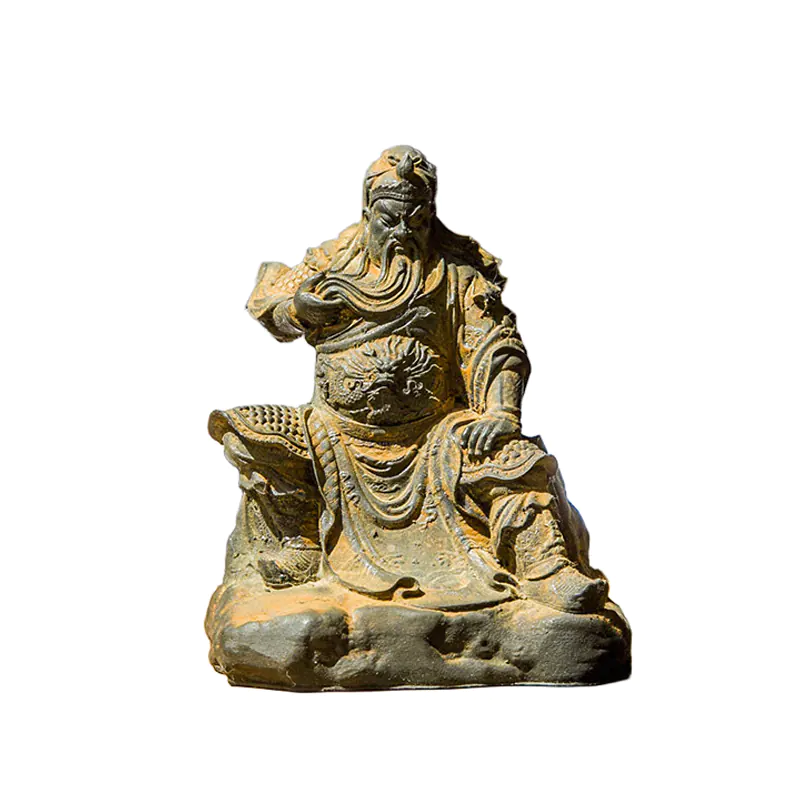
Rustic Cast Iron Finish, Vintage Style Guan Yu Statue – 12×8.4cm (4.7×3.3 inches)
-
Iconic Eastern Decor: A timeless depiction of Guan Yu, the revered Chinese God of War.
-
Symbol of Strength: Represents loyalty, integrity, and protection.
-
Vintage Charm: Features a classic cast-iron finish that adds a touch of history.
-
Compact Size: Perfectly sized to enhance a desk, shelf, or personal altar.
-
Versatile Accent: An ideal piece for home, office, or studio decoration.
The Historical General: Beyond the Romance
To understand the icon, we must first locate the man. Guan Yu (d. 220 AD) was a military general serving under the warlord Liu Bei during the turbulent end of the Han Dynasty and the commencement of the Three Kingdoms period. Historically speaking, the primary source for his life is the Records of the Three Kingdoms (Sanguozhi), a historical text that paints a picture of a man characterized by immense physical bravery and unyielding loyalty.
However, the Guan Yu most the world knows today is derived less from these dry annals and more from the Romance of the Three Kingdoms, a 14th-century historical novel that romanticized the era. In the novel, Guan Yu swears an oath of brotherhood in a peach garden with Liu Bei and Zhang Fei, pledging to die on the same day as his brothers. This concept of Yi—often translated as righteousness, loyalty, or fraternal duty—is the core moral pillar of his legacy.
While Western military history often celebrates tactical genius (think Napoleon or Hannibal), the Chinese veneration of Guan Yu focuses on moral fortitude. He is not worshipped because he was undefeated (he wasn’t; he was captured and executed by the forces of Sun Quan), but because he refused to compromise his code of honor.
The Iconography of Authority: The Weapon and the Image
One cannot discuss this figure without addressing the sheer visual power of his representation. Central to this is the specific Guan Yu weapon known as the Green Dragon Crescent Blade (Guandao). In folklore, this glaive-like polearm weighed an impossible 82 catties (roughly 18kg or 40lbs according to Han measurements, though myth often inflates this).
From an archaeological perspective, we must acknowledge an anachronism: the Guandao as a weapon type likely did not exist during the actual Three Kingdoms period; it was a Song Dynasty invention. Yet, in the cultural consciousness, the man and the blade are inseparable. The weapon represents his martial prowess and his ability to cut through injustice. When viewing a Chinese Guan Yu statue today, the position of the blade often tells a story: if the blade faces upward, he is in a defensive posture; if he holds it driving downward, he is often interpreted as vanquishing evil.
The aesthetic conventions of his statues—the slanted eyes (representing the Phoenix), the silkworm eyebrows, and the red face—are not merely artistic choices. In Chinese opera, a red face symbolizes extreme loyalty and bravery. He is literally wearing his heart on his face, transparent in his virtue.
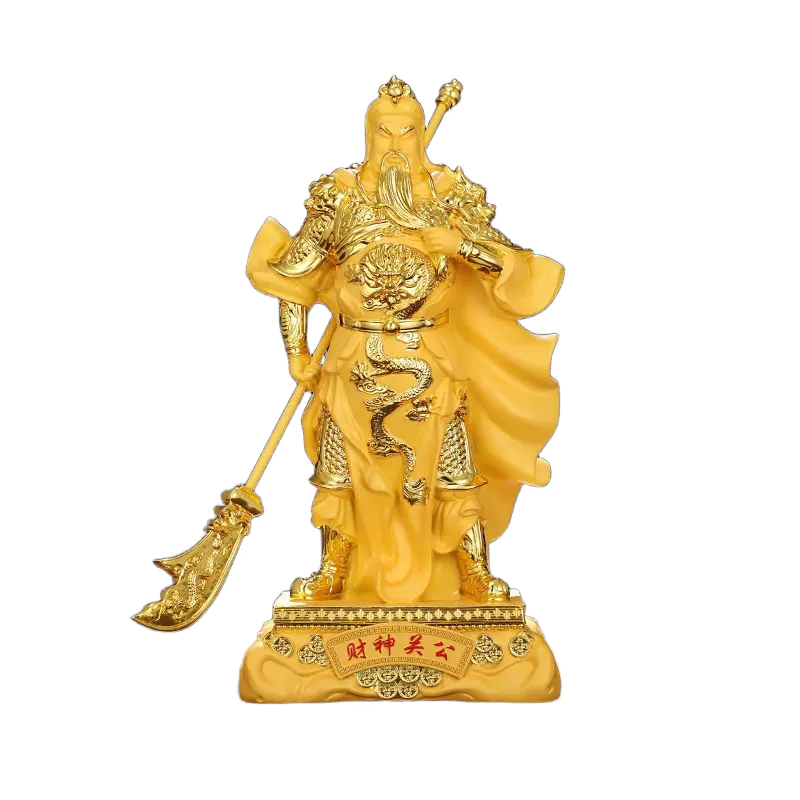
Golden Guan Yu Statue, God of Wealth and Protection – 38cm (15 inches)
-
Symbol of Power & Prosperity: Invite the energy of success and abundance into your space with the legendary Guan Yu, the Martial God of Wealth.
-
Guardian of Integrity: Believed to protect against negative influences and encourage loyalty, honor, and righteousness in all endeavors.
-
Striking Gold Finish: Features a brilliant, eye-catching golden sheen with intricate detailing on the armor and dragon motifs.
-
Statement Piece: Standing at 38cm (15 inches) tall, this statue is a commanding presence, perfect for home, office, or business display.
-
Meaningful Decor: A powerful addition to any space, blending ancient Eastern heritage with a timeless message of strength and fortune.
From General to God: The Apotheosis
How does a general become a Bodhisattva in Buddhism, a Holy Emperor in Taoism, and a sage in Confucianism? This syncretism is unique to Chinese theology.
By the Sui Dynasty (581–618 AD), Guan Yu was already being venerated as a guardian spirit. However, it was during the Ming and Qing dynasties that his elevation reached its zenith. The state realized that promoting the cult of Guan Yu was beneficial; it encouraged loyalty to the Emperor. Consequently, he was granted titles of increasing length and grandeur, eventually becoming “Guan the Holy Great Deity; God of War Manifesting Benevolence, Bravery and Prestige.”
It is a common misconception among Western observers to equate him with Ares or Mars. The Western “God of War” implies a love of conflict. Guan Yu, conversely, is the God of War in the sense of a peacekeeper—he represents the violence used to restore order and protect the innocent. He is invoked to prevent strife, not to cause it.
Material Manifestation: Statues and Monumentalism
For the modern collector or the devout, the physical representation of the deity is a serious matter. The variety in Guan Yu statue size and composition reflects the diversity of his worshippers.
In domestic settings, you will find small, altar-sized figures, often made of brass, wood, or porcelain. These are intimate objects of family worship. However, in the public sphere, the scale changes dramatically. The landscape of mainland China is dotted with colossal representations. A notable, albeit controversial, example was the massive China Guan Yu statue in Jingzhou. Standing over 58 meters tall and weighed in thousands of tons, it was designed to be an awe-inspiring landmark, reinforcing the city’s historical connection to the general. While that specific monument faced regulatory challenges regarding its location, it serves as a testament to the continued desire to manifest his grandeur in physical form.
When we analyze the market for a statue of Guan Yu, we see a fascinating intersection of art and transactional intent. For business owners, placing a gold-plated Guan Yu statue facing the entrance is not merely decorative; it is a spiritual security system. He guards the wealth of the business (as a God of Wealth, a later attribution) and ensures fair dealing. The intent is clear: cheat this establishment, and you answer to the blade.
Furthermore, the provenance matters. A specific Guan Yu statue China produces for export often focuses on the “Warrior” aspect (dynamic poses) for Western martial arts studios, whereas domestic statues may focus on the “Literary” aspect (reading the Spring and Autumn Annals) for government offices or scholars.
The Ink of Loyalty: Guan Yu in Modern Body Art
The professor in me finds the sociological evolution of Guan Yu’s image most fascinating in the realm of subcultures, particularly regarding the Guan Yu tattoo.
In the violent underworld of the Hong Kong Triads (criminal organizations), Guan Yu is a central figure. Paradoxically, the police who hunt them worship the same deity. Inside a Hong Kong police station, a shrine to Guan Yu receives incense to ensure the officers’ safety and loyalty to the force. Simultaneously, Triad members tattoo his image on their backs to signify their loyalty to the gang and their brothers.
However, there is a superstition regarding the Guan Yu tattoo: one must have the “fate” or “strength” to carry it. A common belief suggests that if a person’s astrological destiny is not “heavy” enough to bear the weight of the God of War on their skin, the tattoo will bring misfortune. It is a striking example of how ancient reverence commands respect even in the medium of modern body art.
Enduring Relevance in a Globalized World
Why does a general from 220 AD still command a search volume of thousands per month in the English-speaking world?
Partially, it is the globalization of media. Video games like Dynasty Warriors and Total War: Three Kingdoms have introduced guan yu to a generation of Western gamers who respect him for his stats before they respect him for his spirit. But deeper than that, Guan Yu fills a moral void. In an era of shifting alliances and transactional relationships, the concept of a man who would rather die than betray a sworn brother possesses a magnetic appeal.
Whether you are looking for a Chinese Guan Yu statue to grace a study, or simply reading about the Three Kingdoms to understand the foundational myths of East Asia, you are engaging with a figure who has successfully conquered death. He is no longer just a general; he is a moral absolute.
For the student of history, Guan Yu serves as a reminder that history is not just about what happened—it is about what we choose to remember. The Chinese civilization chose to remember loyalty above all else, and in doing so, they built a God out of a man.
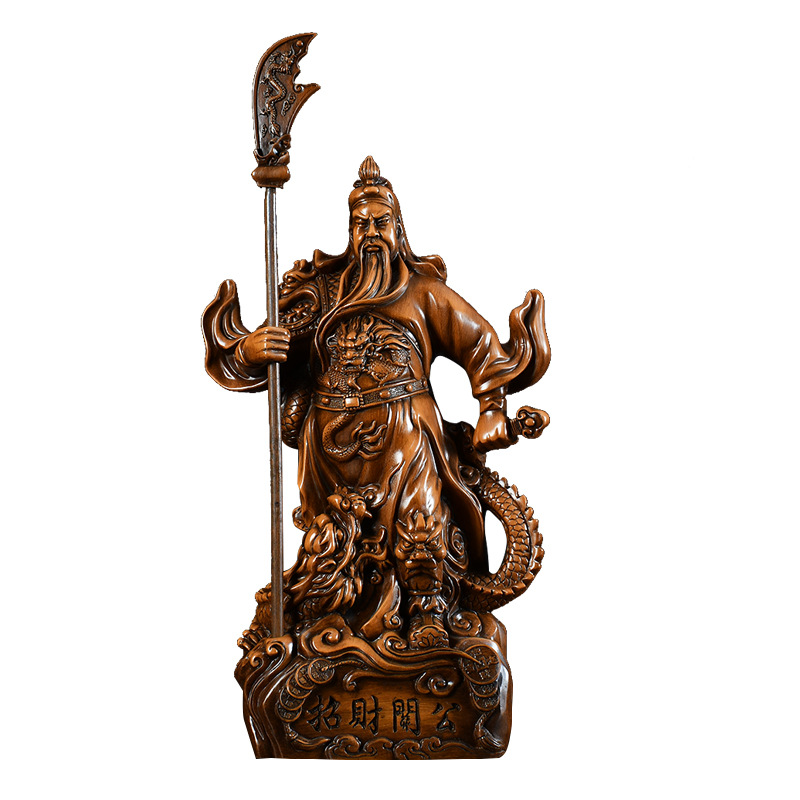
Auspicious Dragon Guan Gong
Key Features:
-
Symbol of protection, wealth, and good fortune
-
Resin craftsmanship with detailed bronze finish
-
Ideal Feng Shui decor for home, office, or business
