
If you walk into a traditional Chinese restaurant, a police station in Hong Kong, or even a martial arts dojo in Chinatown, you are almost guaranteed to see him. He is usually red-faced, has a magnificent beard that defies gravity, and is holding a massive polearm. That is Guan Yu.
But before he became a god, before the massive Guan Yu statue became a fixture in millions of homes, and before he was the subject of video games and movies, he was just a fugitive running from the law. And he wasn’t alone.
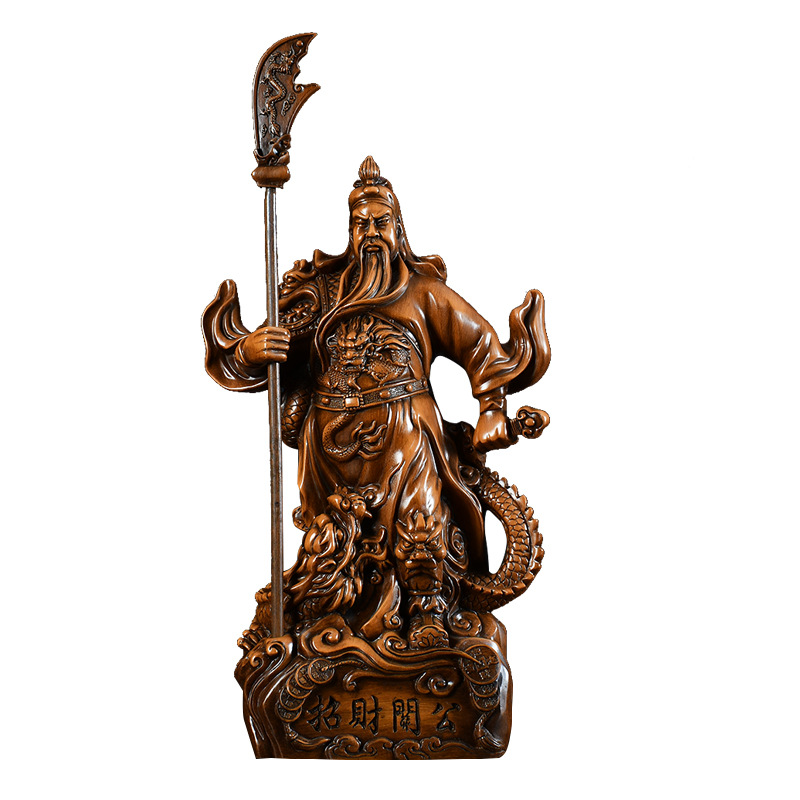
Auspicious Dragon Guan Gong
Key Features:
-
Symbol of protection, wealth, and good fortune
-
Resin craftsmanship with detailed bronze finish
-
Ideal Feng Shui decor for home, office, or business
To understand the Chinese psyche regarding loyalty, you have to understand the “Oath of the Peach Garden.” It is the moment three nobodies—a shoe seller, a fugitive, and a butcher—decided to become brothers. It is a story that blurs the line between history and fiction, but as we often say in this field, the legend is usually more powerful than the fact.
The Setting: A World on Fire
Let’s set the scene. The year is roughly 184 AD. The Han Dynasty, which had held China together for four centuries, is crumbling. It’s a mess. The government is corrupt, the eunuchs in the palace are running the show, and out in the countryside, a massive peasant uprising known as the Yellow Turban Rebellion is burning villages to the ground.
The government, desperate for bodies to throw at the rebels, puts out a call for volunteers. Essentially: “If you can hold a spear, we need you.”
This is where our three characters converge in Zhuo County.
First, you have Liu Bei. History paints him as the benevolent hero, but at this point, he’s a tall man with long arms and big ears (a sign of luck), selling straw sandals and mats on the street corner. He claims to be a distant relative of the Emperor—the “Uncle” of the current ruler. In the chaos of the Han genealogy, this was hard to prove but impossible to disprove. He has ambition, but no cash.
Then enters Zhang Fei. He’s a local wealthy butcher with a temper shorter than a burning fuse. He loves wine, loves a fight, and has the capital to fund a militia.
And finally, the heavy hitter: Guan Yu.
The Red-Faced Giant
When we talk about the aspect of Guan Yu, we are talking about a figure who is larger than life. In the classic novel Romance of the Three Kingdoms, he is described as nine feet tall with a two-foot-long beard, a face like a dark red date, and lips like painted grease.
He arrives in town pushing a cart or fleeing from a crime—depending on which version you believe, he had killed a local bully in his hometown and was on the run.
Now, usually, when three strong personalities meet in a bar (or a tea house, in this case), it ends in a brawl. And in some folktales, they did fight first just to see who was tougher. But the standard legend tells us they bonded over a shared despair for their country. They saw the chaos, the suffering of the people, and realized that individually, they were useless. But together? They might just be able to save the empire.
The Oath
Zhang Fei, the one with the property, suggests they go to the peach orchard behind his house. The peach trees are in full bloom—a symbol of spring, renewal, and longevity.
They prepare a sacrifice. Usually, this involves a black ox and a white horse. They burn incense and bow to the heavens. And they speak the words that have been recited by triads, secret societies, and sworn brothers for nearly two thousand years:
“We, Liu Bei, Guan Yu, and Zhang Fei, though of different surnames, bind ourselves as brothers. We swear to serve the state and save the people. We ask not the same day of birth, but we seek to die on the same day. May Heaven and Earth attest to our hearts. If we turn aside from righteousness and forget kindness, may Heaven and man smite us!”
This is the core of the legend. “We seek to die on the same day.”
It is romantic, reckless, and incredibly powerful. In a world where betrayal was the standard currency of politics (just look at their rival, Cao Cao), these three offered absolute, unwavering loyalty. Liu Bei became the Eldest Brother, Guan Yu the Second Brother, and Zhang Fei the Third.
The Tools of the Trade
After the oath, they needed gear. You can’t save an empire with a butcher’s knife and straw sandals. Since Zhang Fei had the money, they hired local smiths to forge their weapons.
This gives birth to the iconic Guan Yu weapon, known as the Green Dragon Crescent Blade. It’s a guandao—a heavy curved blade atop a long pole. The legend says it weighed 82 catties (which would be over 40kg or 100lbs today). Now, historically, this type of weapon didn’t actually exist during the Han Dynasty; it appeared centuries later during the Song Dynasty. But history is boring, and the image of Guan Yu swinging a 100-pound razor blade on horseback is cool, so the image stuck.
With these weapons and a small band of volunteers, they set out to quell the rebellion.
From Men to Icons
The tragedy and the beauty of the story is that they didn’t manage to save the Han Dynasty. The empire fell apart anyway. But their struggle to hold it together defined the era.
Over the centuries, the Second Brother, Guan Yu, eclipsed the others in popularity. He became the epitome of Yi (righteousness/loyalty). He is unique because he is worshipped by both sides of the law.
If you look at a Chinese Guan Yu statue in a police station, he is usually holding his weapon in the right hand, signifying the use of force to uphold justice. If you walk into a triad gangster’s hideout, you might see a statue of Guan Yu holding the blade in the left hand, or wearing different colored robes, signifying loyalty to the brotherhood above the law of the land.
This cultural ubiquity is fascinating. I’ve had students ask me about the guan yu statue size—specifically referring to the colossal monument that was built in Jingzhou a few years back. It was 58 meters (190 feet) tall! It was so heavy the ground started sinking beneath it, and the government eventually ordered it to be moved because it was considered “vain and wasteful.” But the fact that someone spent roughly $25 million to build a robot-sized statue of a general from 200 AD tells you how deep this legend runs.
Even on a smaller scale, the China Guan Yu statue market is massive. You can buy them in porcelain, bronze, wood, or gold. They are placed facing the door to ward off evil spirits and bad luck. The belief is that Guan Yu’s aura is so formidable that demons (and tax auditors, presumably) are too scared to enter.
The Modern Ink
It’s not just statues. In recent decades, the aspect of Guan Yu has migrated to skin. The guan yu tattoo is a serious commitment in the West and the East.
In the tattoo world, there is a superstition—mostly in Asia—that not everyone has the “fate” strong enough to carry a Guan Yu tattoo. He is too heavy, spiritually speaking. If you are a weak person and you get a full-back piece of the God of War, it might crush your fortune.
But for those who get it, it symbolizes a code. It says: “I value loyalty over money.”
Why It Matters to the West
Why should a Western audience care about three guys drinking wine in an orchard 1,800 years ago?
Because it breaks the stereotype of Chinese history being purely about bureaucracy, emperors, and obedient subjects. The Peach Garden Oath is about agency. It’s about three regular guys looking at a broken system and saying, “We’re going to fix this ourselves.”
It is the ultimate underdog story. They spent years losing. They were beaten, separated, and nearly killed dozens of times. Liu Bei even had to abandon his family at one point (not his finest moment, I admit). But they always found their way back to each other.
When Guan Yu was captured by the enemy warlord Cao Cao, he was offered everything: gold, women, high rank, and the finest horse in the land (Red Hare). Cao Cao respected him immensely. Yet, Guan Yu left it all behind the moment he heard his brother Liu Bei was alive. He rode through five passes and slew six generals just to get back to his penniless, landless brother.
That is the narrative hook. It’s not about the war; it’s about the relationship.
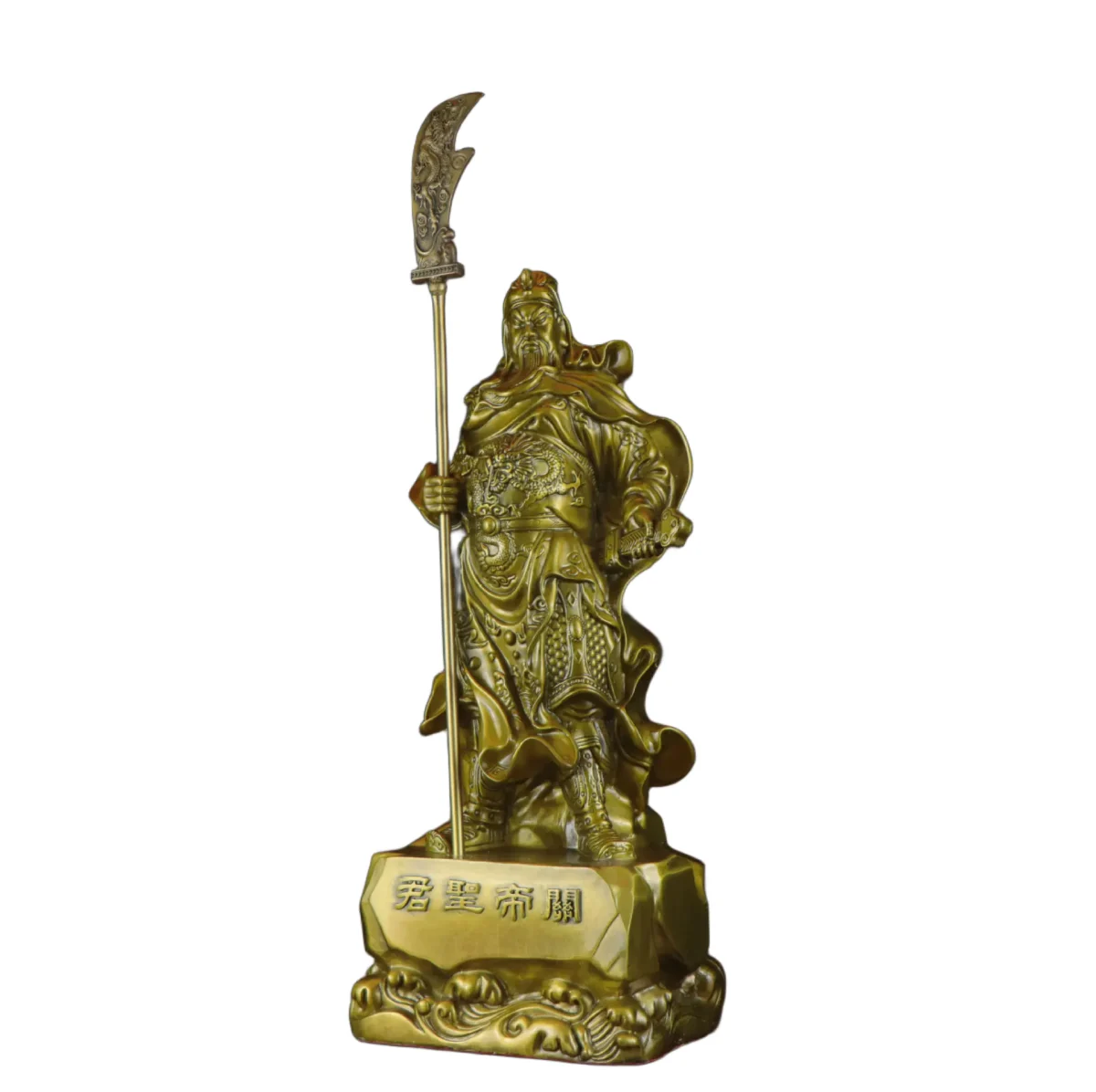
Brass Guan Di Sheng Jun Statue of General Guan Yu
-
Dimensions and Weight: Approximately 15 x 12 x 40 cm (5.9 x 4.7 x 15.7 in); total height with blade is approximately 47 cm (18.5 in), weighing 4.5 kg (9.9 lbs).
-
Solid Brass Material: Cast in high-quality brass, this substantial sculpture features a classic metallic finish and a stable base for long-term display.
-
Traditional Symbolism: Depicts the deified General Guan Yu, a historical figure symbolizing moral integrity, loyalty, and protective energy in Eastern culture.
The Reality Check
Now, as a professor, I have to give you the pinch of salt. Did the Peach Garden Oath happen exactly like that? Probably not. The official history, the Records of the Three Kingdoms, mentions they shared a bed and treated each other like brothers, but it doesn’t explicitly detail the black ox, the white horse, and the flowering trees. That was likely embellished by the storyteller Luo Guanzhong in the 14th century when he wrote the novel.
But does it matter?
When you see a statue of Guan Yu in a shop in London or San Francisco, you aren’t looking at a historical artifact. You are looking at an idea. You are looking at the human desire for a friend who will never stab you in the back.
So, the next time you see that red-faced figure with the long beard and the heavy weapon, don’t just think of him as a “God of War.” Think of the shoe seller and the butcher standing next to him in a garden, making a promise that they actually kept. In the end, they didn’t save the dynasty, but they saved each other’s names from being forgotten. And in history, that is a victory in itself.
