
In our fast-paced modern world, we are often conditioned to view life as a series of goals to be achieved. We apply this same mindset to our spiritual lives: we meditate to “get” calm, we practice mindfulness to “achieve” clarity, and we look toward spiritual awakening as a distant finish line—a place where all our problems will finally disappear.
However, in the autumn of 2014, the late Zen Master Thich Nhat Hanh (affectionately known as Thay) shared a profound reflection with his students. In a heartfelt letter dictated as his physical health began to wane, he offered a radical shift in perspective. He taught that true practice is not about escaping to a distant Nirvana or worshipping a god-like figure. Instead, it is about the “encounter”—the intimate meeting with reality, with our own humanity, and with the world right beneath our feet.
To find the sacred, we do not need to look up; we need to look down at where we step.
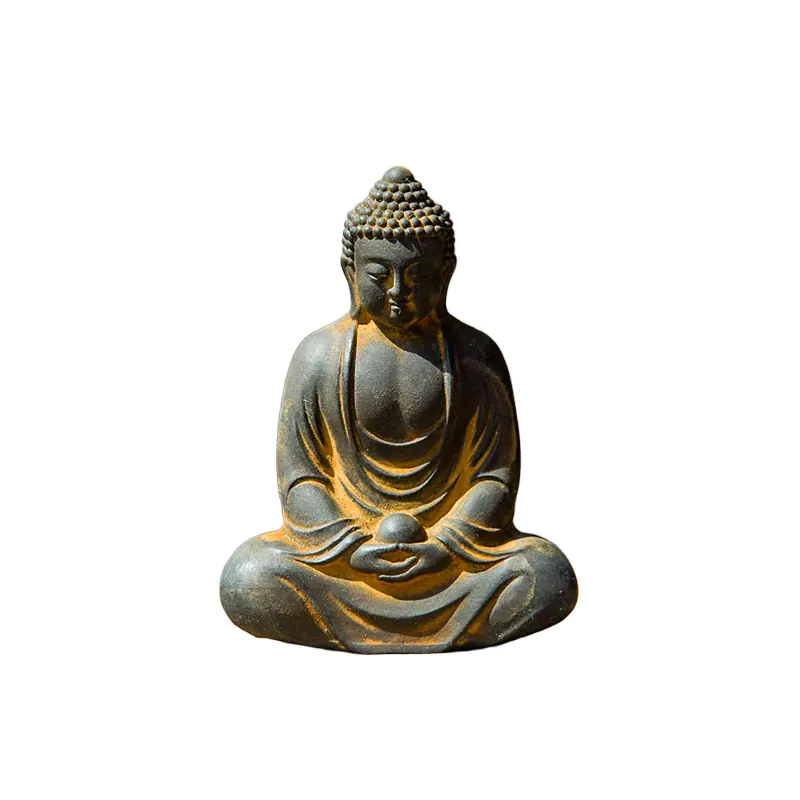
Rustic Cast Iron Finish, Meditating Buddha Statue for Home Decor, Antique Finish – 10 cm / 3.9 inches
-
Create a Peaceful Atmosphere: Adds a touch of Zen and tranquility to any room.
-
Antique Rustic Finish: Features a weathered, textured look that brings a sense of history and calm.
-
Compact & Versatile: The perfect size for shelves, desks, meditation spaces, or small garden nooks.
-
Durable & Lightweight: Crafted from quality resin for lasting beauty and easy placement.
Dismantling the Myth of the Distant God
For many in the West, Buddhism initially appears exotic, filled with iconography of golden statues and supernatural legends. Thay touched upon this in his reflections on his own youth. When he entered the monastery at age sixteen, the historic Buddha—Siddhartha Gautama—was presented not as a human teacher, but as a legendary figure with supernatural powers, haloed by miracles.
The liturgy of his early years was dominated by the Tantric tradition and Pure Land chanting. Young monks would recite the Surangama Mantra, visualizing a Buddha radiating light, surrounded by formidable Dharma protectors wielding diamond thunderbolts to crush evil. While these images instilled awe and devotion, they also created a massive distance. As Thay wrote, “We called the Buddha ‘our Teacher,’ but in reality, there was a huge distance between us and Siddhartha.”
It took decades of critical thinking and deep looking for Thay to peel away the layers of deification and rediscover the human being beneath the myth. This journey culminated in his writing of Old Path White Clouds, a book that sought to liberate the Buddha from the halo of mystery. He wanted to reveal a teacher who walked, sat on a cushion of grass, ate with his community, and faced difficulties with compassion rather than magic.
For the modern seeker, this distinction is vital. If we view the Buddha (or any spiritual ideal) as a god who will save us, we remain passive. But if we view the Buddha as a confidant—a “soulmate” who faced the same human conditions we face—then the path becomes accessible. We realize that the capacity for awakening is not a divine gift, but a human skill.
The Illusion of Escape: Nirvana is Now
One of the most persistent misconceptions in spirituality is the idea of “escape.” We often subconsciously believe that if we practice hard enough, we will transcend the messiness of life and enter a state of permanent bliss, untouched by the world’s pain.
In his letter, Thay critiqued a traditional vow often taken by monks: “I vow not to enter Nirvana until all beings are saved.” On the surface, this sounds like the ultimate act of compassion. However, Thay pointed out a deep logical flaw in this thinking. It assumes that Nirvana is a place you go to rest after the work is done—a place without suffering.
But if Nirvana is a place where you “do nothing but enjoy,” how can you help anyone?
This reveals a profound teaching on Interbeing: the interconnectedness of all things. We often view happiness and suffering as enemies—we want the happiness (the lotus) without the mud. But the teaching of Interbeing reminds us that without the mud, the lotus cannot grow. Without the experience of the cold, we cannot appreciate the warmth of a heavy coat.
Therefore, the “Pure Land” is not a sterile paradise free of the five skandhas (form, feelings, perceptions, mental formations, and consciousness). It is not a place where we strip away our humanity. True Nirvana is the capacity to be present with our humanity without being drowned by it. It is the peace found in the midst of action, not away from it.
The “Encounter” in Every Step
If the destination isn’t an escape, then the practice must be the journey itself. This brings us to the concept of the Dharma Body. Originally, in early Buddhism, this simply meant the body of teachings—the concrete methods of dealing with suffering. Over centuries, however, Mahayana theology expanded this into a cosmic concept (Vairochana), turning the universe itself into the body of the Buddha.
While poetic—viewing the white clouds and the rivers as the preaching of the Dharma—Thay urges us to return to the practical. The Dharma Body is only real if it is lived. It is not enough to worship the cosmic Buddha; we must embody the practice.
This is why the Sangha Body—the community of practitioners—is so essential. Thay noted that even if a monk can chant beautifully or hold a high rank in the hierarchy, without the ability to listen deeply, speak lovingly, and reconcile conflicts with his brothers and sisters, he has not accomplished anything. The “sacred” is found in how we treat the person sitting next to us.
For our modern lives, this changes everything. The “encounter” is the moment you stop running toward the future and truly meet the present.
- It is the encounter with your own difficult emotions (the “mud”) without pushing them away, acknowledging them as part of the organic compost of life.
- It is the encounter with your loved ones, moving beyond superficial roles to offer the gift of true presence.
- It is the encounter with the earth, walking not to get to the car or the office, but walking just to walk, knowing that “the miracle is not to walk on water, but to walk on earth.”
Being a Critical Friend to the Truth
Perhaps the most liberating aspect of Thich Nhat Hanh’s teaching is his encouragement of intellectual freedom. Referencing the Kalama Sutra (the Charter of Free Inquiry), the Buddha told his followers not to believe in anything simply because it is written in a scripture or spoken by a famous teacher. We must test it with our own experience.
We are not meant to be blind followers. We are invited to be the Buddha’s confidants. This means we must discern between cultural trappings (like the frightening Dharma protectors of old mythology) and the essence of liberation (the practice of peace).
We do not need to visualize a Buddha with a “tongue that covers the face” or a body that is “100 feet tall”—imagery that was meant to impress ancient cultures but often alienates the modern mind. We need only to look at the historical dimension: a human being who sat, breathed
Conclusion: You Have Arrived
The overarching message of Thay’s letter is that we must stop waiting. We are not waiting for a future Enlightenment to descend upon us, nor are we waiting to die so we can enter a Pure Land.
As you move through your day, remember that the ground beneath you is the only ground you have. If you cannot find peace here, with the traffic and the noise and the difficult emails, you will not find it in a distant galaxy or a mythological heaven.
By looking critically at dogma, by embracing our community (Sangha), and by accepting that happiness and suffering are interwoven, we stop trying to leave the world and start trying to heal it.
The bells are ringing, the birds are singing, and your feet are touching the earth. The encounter is happening right now. As the Zen Master reminds us: you have arrived. You are home.
