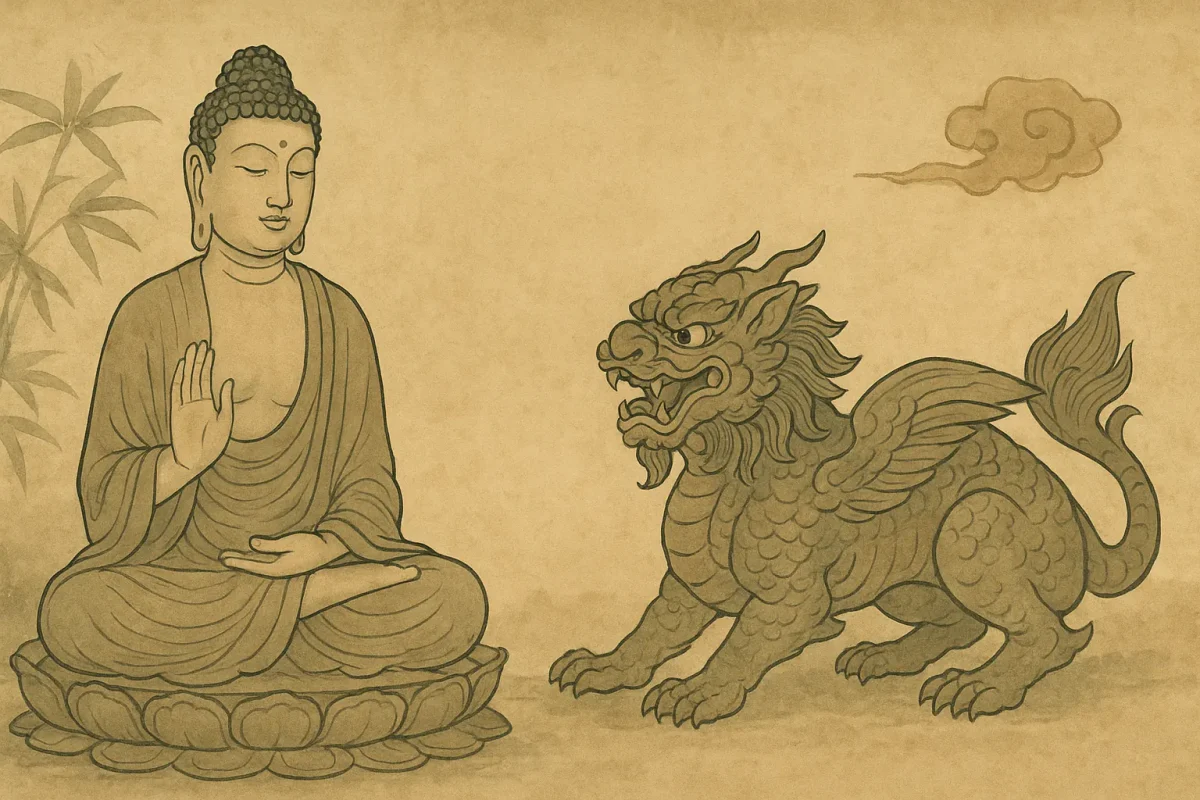
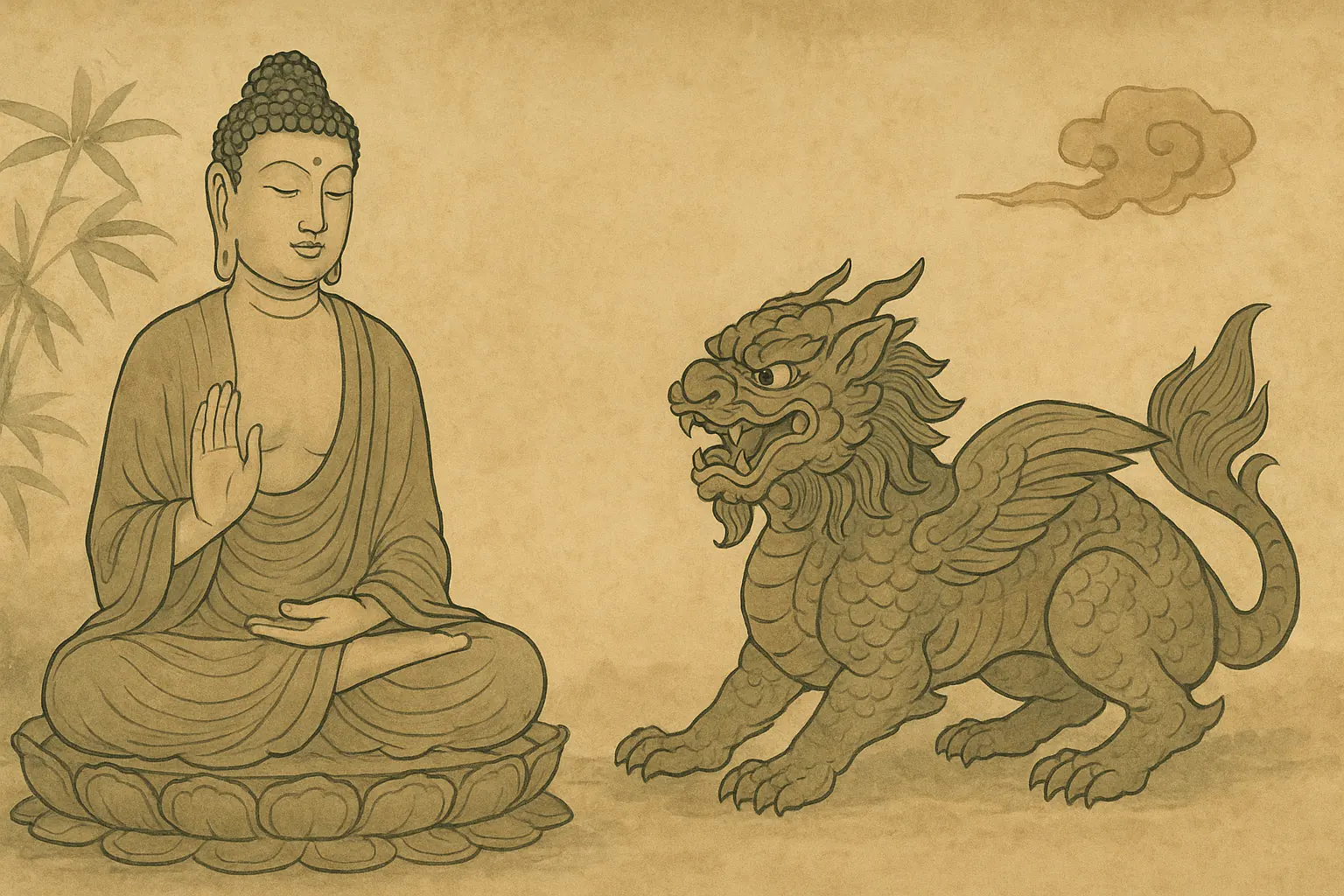
The Buddha sits in stillness. Eyes half-closed, hands resting in the lap or raised in gesture of teaching, unmoved by wind or want. Nearby, on another shelf perhaps, a Pixiu crouches—wings folded, mouth open, ready to gather what the world offers. One seems to withdraw from the flow of things; the other leans into it.
They are often placed side by side, grouped under vague headings like “Eastern symbols” or “spiritual art.” But their purposes do not stem from the same root. One grows from a path of liberation, the other from a science of placement.
Buddha images were not always made. For generations after his passing, followers honored the Awakened One through absence—a footprint on stone, an empty seat beneath a tree, a stupa holding relics. The form came later, not to invoke favor, but to evoke memory: of clarity, of compassion, of the possibility that suffering can end. The statue is not a being to petition. It is a mirror. When one looks upon it, the invitation is not “grant me peace,” but “remember your own capacity for it.”
This is why traditional practice treats the image with care—not out of superstition, but respect for what it represents. Placing it in a space of distraction or disregard isn’t “bad luck”; it simply misses the point. The Buddha’s silence is not magical. It is instructional.
Feng shui figurines operate in a different register altogether. They belong not to the realm of awakening, but to the art of alignment. In the Chinese cosmological view, life unfolds within a web of energies—qi—shaped by mountains, rivers, directions, seasons. Human well-being depends, in part, on how one navigates this invisible current.
Thus, symbolic creatures enter the home not as teachers, but as agents. The Pixiu, mythically forbidden to excrete, draws wealth and holds it. The Qilin, gentle yet mighty, steps lightly over chaos to restore balance. Dragons coil with power; turtles carry the weight of longevity on their shells. These are not objects of devotion, but instruments of intention—chosen, positioned, and sometimes ritually prepared to interact with the unseen architecture of space.
Their effectiveness is tied not to inner transformation, but to correct orientation. A Pixiu facing a wall cannot gather; a dragon in the wrong sector may stir restlessness instead of authority. The system is precise, pragmatic, and deeply tied to context.
It is true that, over centuries in parts of Asia, these streams have mingled. A household altar might hold a small statue of Guanyin—the bodhisattva of compassion—next to a brass wealth bowl. Temples may feature feng shui ponds alongside meditation halls. But coexistence does not imply equivalence.
Buddhism, at its heart, turns attention inward. It asks: What is the nature of craving? Can the mind be free? Feng shui turns attention outward: How does energy move through this room? Where does fortune gather? One seeks to dissolve the illusion of separation; the other works skillfully within it.
To confuse them is understandable. Both speak in symbols. Both emerge from cultures that value harmony. But one points to a reality beyond conditions; the other seeks to improve the conditions themselves.
There is no need to choose between them. But there is value in seeing clearly. A Buddha image does not bring luck. A Pixiu does not offer enlightenment. Each has its place—not in opposition, but in distinction.
And perhaps, in that distinction, something quieter emerges: the recognition that human beings have always sought both—inner peace, and a life well-arranged.