
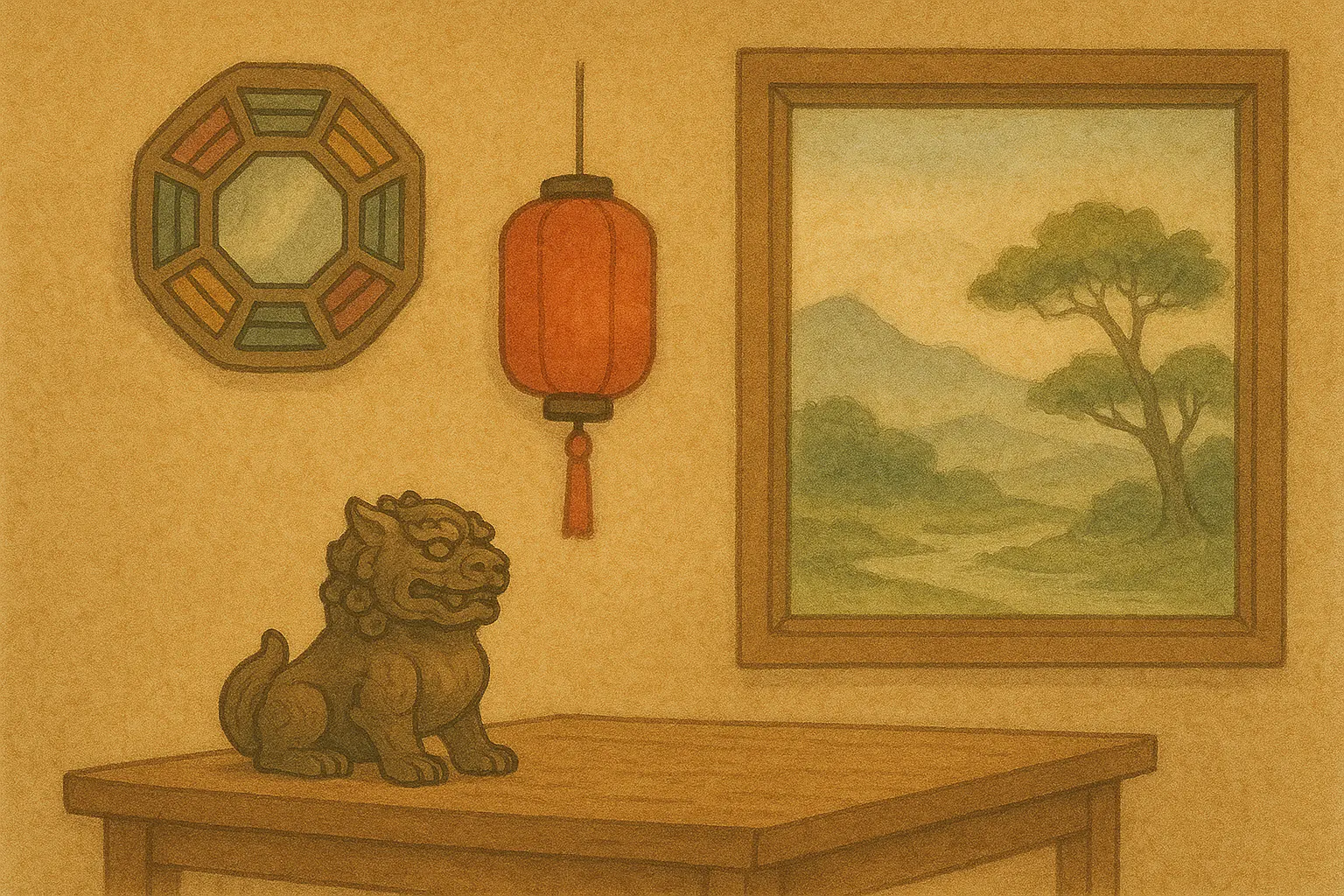
You might place a small bronze Pixiu near your desk. Not because you expect coins to rain from the ceiling. But because, for a moment each morning, as you sit down to work, you remember: I want to honor what comes to me. I want to hold it well.
That’s where feng shui begins—not with spells, but with attention.
The old masters didn’t start by carving dragons or painting bagua mirrors. They started by standing on a hill at dawn, watching how mist moved through a valley. They noticed that homes nestled against a gentle slope, facing open water, stayed warmer in winter, drier in rain, calmer in storm. They saw how a crooked path slowed the wind, how a courtyard filled with light lifted the spirit.
From that watching came a language—a way to speak with space, with direction, with material. And over time, that language grew symbols: creatures, shapes, colors. Not as shortcuts to fortune, but as anchors for mindfulness.
The Pixiu, with its fierce eyes and sealed rear, isn’t a money machine. It’s a reminder that wealth flows to those who protect what they have and give with generosity. The Qilin, serene yet powerful, isn’t a shield against ghosts—it’s an emblem of the kind of presence that turns conflict into harmony. Even the turtle, slow and steady, speaks not of luck, but of endurance: Build your life on something that lasts.
These figures entered homes because people wanted more than function. They wanted meaning woven into the fabric of daily life. A doorway wasn’t just an exit—it could be aligned to welcome opportunity. A windowsill wasn’t just a ledge—it could hold a symbol that whispered, You are supported.
And yes, the system grew complex. Compasses filled with rings, charts mapping yearly stars, debates over which corner holds wealth. But beneath all that, the heart remains simple: How can I live in a way that feels aligned—body, mind, and space?
No one needs to “believe in qi” as if it were a ghost. But most of us have felt it: the unease of a room where the door slams you in the face, the calm of a space where light falls softly, the relief of a bed that doesn’t face a mirror in the dark. Feng shui gives words to those feelings. And sometimes, a small statue gives them a face.
So when someone places a feng shui figure in their home, they’re not casting a spell.
They’re making a quiet promise—to live with more awareness, more care, more hope.
The statue doesn’t do the work.
You do.
But having something beautiful, ancient, and intentional beside you?
That can be the gentlest kind of company.
