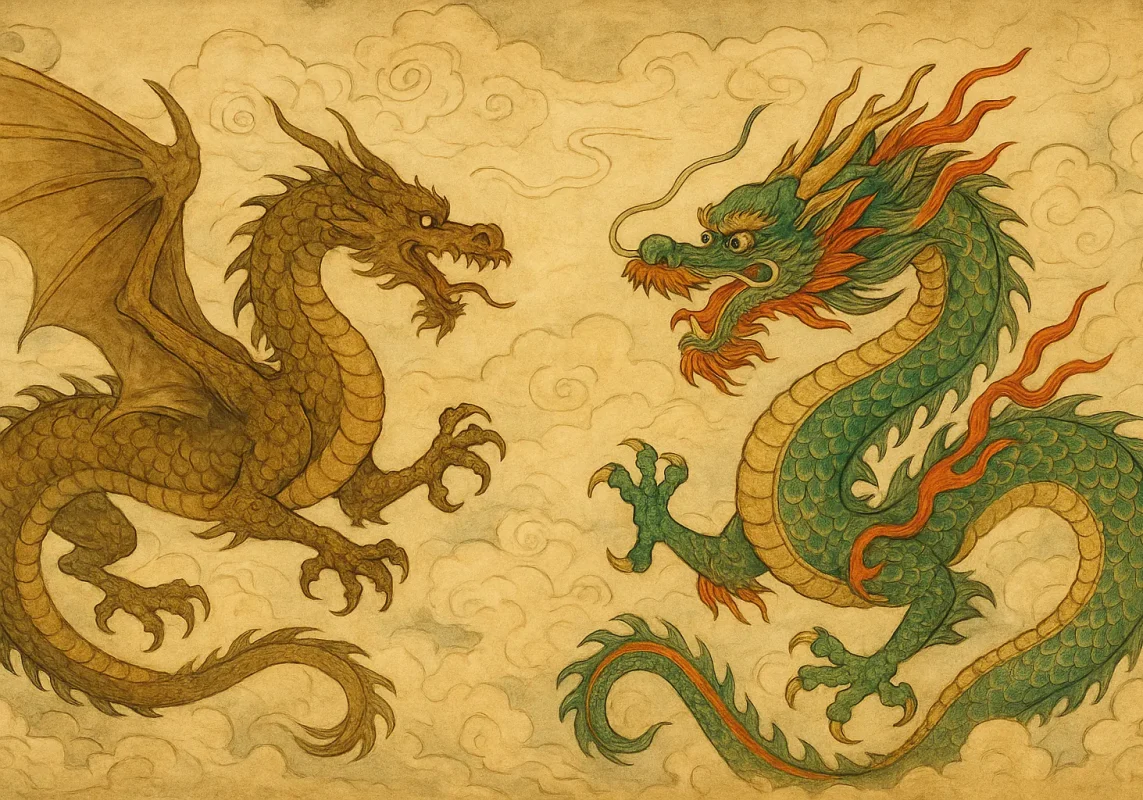
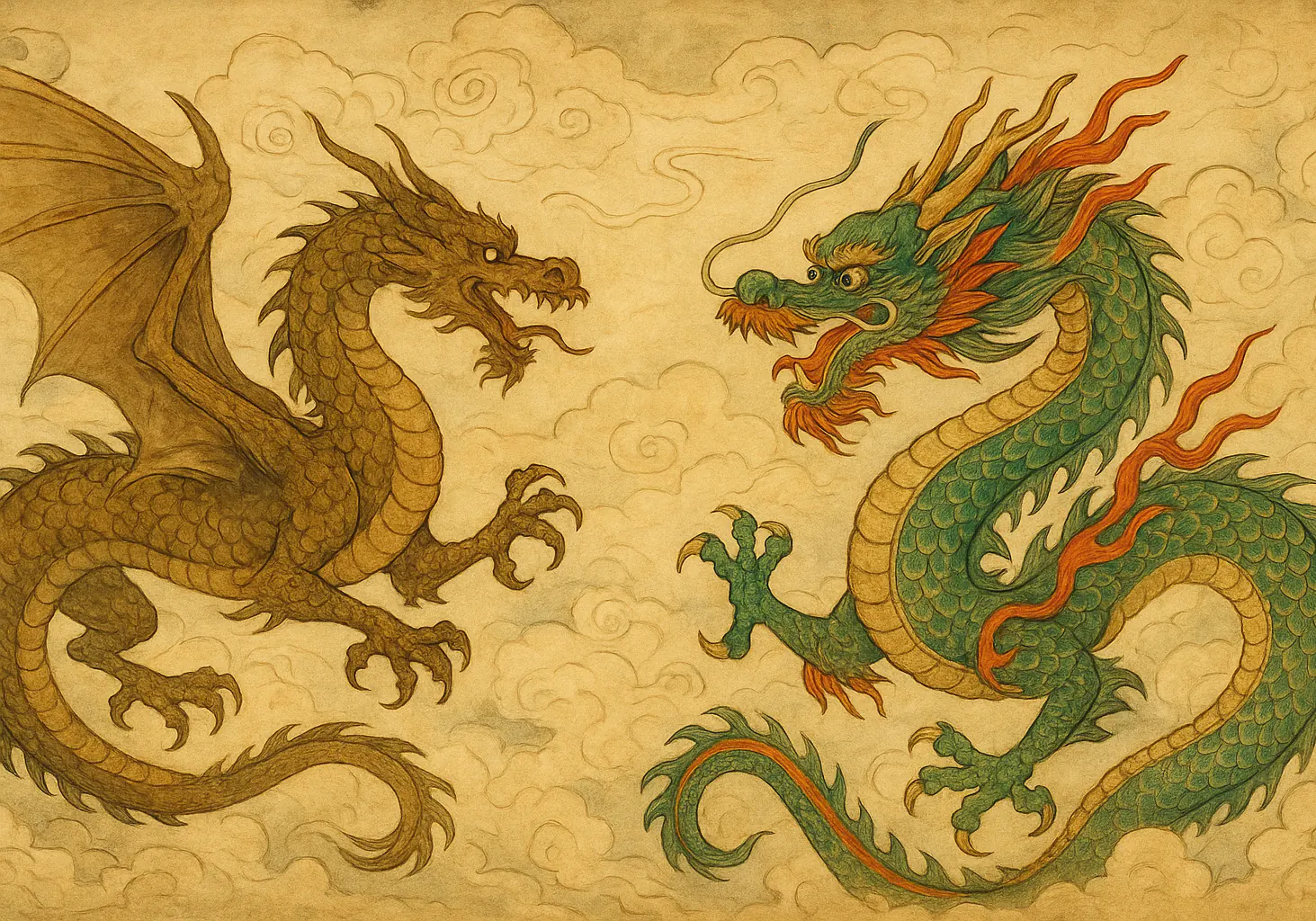
It starts with a simple translation, a word we think we know. Say “dragon,” and a very specific image flares to life in the Western imagination: a monstrous, winged reptile, a creature of chaos and fire. It’s the beast at the heart of our oldest stories, a thing to be conquered. But that image, the one seared into the Western imagination, creates a blind spot. It’s a magnificent, terrifying, and almost complete misreading of a creature from the other side of the world that happens to share the name: the Chinese Loong.
The disconnect is a kind of cultural whiplash. Look up “dragon” in the Oxford English Dictionary, and the definition will confirm all our fairytale fears: a “mythical monster,” a “huge and terrible reptile,” the embodiment of chaos and evil. It is the ultimate antagonist. The Chinese word, 龙, pronounced “lóng,” carries a universe of opposite meaning. It’s not a monster; it’s a symbol of auspicious power, good fortune, and imperial authority. The failure of a single English word to capture this distinction has created a quiet, persistent barrier to cultural understanding.
Our dragon is a creature of brute physicality. Think of the archetypal hero, Saint George, his lance piercing the scaly hide of the beast to save the princess. This is a foundational myth of conquest, a representation of Christian virtue triumphing over pagan evil. The dragon is the other, the wilderness, the sin that must be slain for civilization and salvation to prevail. You can see it in the tense, coiled bodies of dragons in medieval European manuscripts, their bat-like wings taut, their purpose malevolent. They are hoarders of gold, destroyers of towns, their fire a literal and metaphorical representation of greed and destruction.
The Loong, by contrast, is an ethereal composite, a creature of transcendent power. It has the serpentine body of a snake, the antlers of a deer, the claws of an eagle, and the scales of a carp, but pointedly, no wings. Its ability to fly is not mechanical but magical, a testament to its divine nature. Gaze upon a Ming dynasty porcelain vase, perhaps in the halls of the British Museum or the Met, and you see the Loong not as a static monster, but as a dynamic force of nature. It undulates across the ceramic sky, chasing a flaming pearl—a symbol of wisdom, spiritual energy, and truth. This is not a beast to be killed; it is the embodiment of the emperor himself, a celestial guardian whose presence ensures prosperity. The five-clawed dragon, in particular, was an emblem reserved exclusively for the emperor, a symbol of ultimate power and control over the elements.
These profound differences stem from divergent cultural wellsprings. The Loong was born from an agricultural civilization’s deep reverence for the natural world. Ancient Chinese society, dependent on the rhythms of rain and rivers for survival, saw the Loong as the master of water. It was a deity of rainfall, storms, and floods—a powerful, unpredictable force that had to be respected and appeased, not conquered. People would pray to the Dragon King for timely rains and bountiful harvests, understanding that their existence was intertwined with this creature’s elemental power. The Western dragon’s lineage, however, is tangled with primordial chaos monsters of Mesopotamian myth and was later forged in the fires of religious dogma. Within the Christian framework, the dragon became irrevocably linked to Satan, the serpent in the Garden of Eden. It evolved into a symbol of heresy and paganism, a demonic force that heroes of the faith were destined to vanquish as a demonstration of their piety and God’s power.
This ancient iconography bleeds directly into our modern cultural landscape, often perpetuating the original misunderstanding. Hollywood provides the most potent examples. Consider Smaug from The Hobbit, a creature Tolkien himself drew from the dragon of Beowulf. Smaug is the Western dragon writ large: impossibly ancient, insatiably greedy, cynical, and utterly destructive. He is a cataclysmic event, a personification of avarice who is ultimately slain by a mortal hero, his hoard of gold liberated. This powerful narrative reinforces the dragon as an obstacle, a great and terrible evil to be overcome.
Meanwhile, contemporary Chinese artists are actively engaging with their own ancient symbol, questioning and reinterpreting its meaning in a globalized world. The late artist Xu Bing’s work Cultural Animal offers a provocative commentary on this cross-cultural friction. In the 1994 performance piece, a live pig, stamped with nonsensical Roman letters, was placed in an enclosure with a mannequin covered in Xu Bing’s invented, unreadable “Chinese” characters. The piece is a stark, almost absurd, look at how cultural symbols are transmitted and often grotesquely misunderstood, their surfaces appropriated without a grasp of their deeper meaning. It forces a confrontation with the very nature of our assumptions when we try to interpret another culture’s “language,” be it written or symbolic.
To see the Chinese Loong only through the lens of the Western dragon is to miss the point entirely. It is a failure of the imagination. The Loong proposes a different kind of power, not one of brute force and destruction, but of wisdom, prosperity, and harmony with the forces of nature. Recognizing the vast chasm between “Loong” and “dragon” is more than a linguistic correction; it is an invitation to step outside a narrative of inherent conflict. It’s an opportunity to see a symbol not as a monster demanding a hero to slay it, but as a bridge to a different way of seeing the world, one built on dialogue rather than conquest.