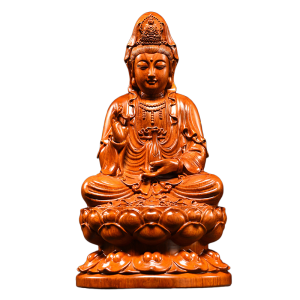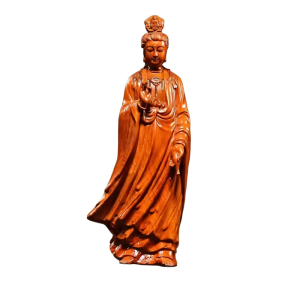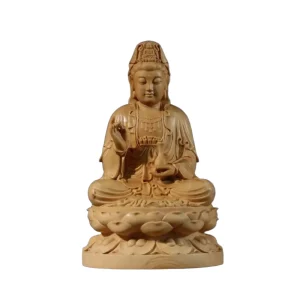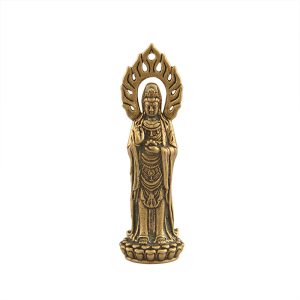
You have seen her in the quiet corners of antique shops or standing amidst the ferns in a garden center. She is elegant, draped in flowing silks, perhaps holding a porcelain vase or balancing atop a swirling dragon. She radiates a stillness that feels different—softer, more accessible—than the austere, meditative figures surrounding her.
“Is this a female Buddha?” is the question that usually follows.
It is a natural confusion. They share the same lineage, the same calm, and often the same shelf space. Yet, Quan Yin (formally known as Guanyin) and the Buddha are not interchangeable. They represent two distinct currents in the vast river of Eastern philosophy. One is the mountain peak; the other is the outstretched hand.
To bring these figures into your home is to invite a specific energy. Understanding the nuance between Quan Yin vs. Buddha allows you to choose not just a statue, but an atmosphere.
The Peak and the Path
Think of the Buddha—specifically Shakyamuni—as the ultimate destination. He represents Enlightenment, the final arrival at the truth. His energy is one of deep, internal solitude. When you look at a Buddha statue, you are looking at someone who has transcended the noise of the world. He is the CEO of the spirit, detached and serene.
Quan Yin is different. She represents the Bodhisattva—an enlightened being who paused at the doorway of paradise and refused to enter. She turned back. She vowed to stay in the dust and chaos of the human world until every single soul was free from suffering.
If the Buddha is the teacher demanding silence to find wisdom, Quan Yin is the counselor listening to your troubles. Her energy is not about detachment; it is about connection. She is the active force of compassion, the “Case Worker” of the divine.
A Shift in Gender
This figure was not always female. If you search for who is Quan Yin in the archives of history, you will find a male figure named Avalokiteshvara in early India. But as Buddhism traveled along the Silk Road and took root in China, the figure underwent a profound transformation.
The Chinese culture, yearning for a deity that embodied mercy, gentleness, and maternal care, slowly reimagined him. By the 12th century, the transformation was complete. The male figure dissolved into the female Guanyin. She became the Goddess of Mercy, a figure less concerned with rigid philosophy and more concerned with the immediate relief of pain. She became the mother who hears the cries of the world.
Reading the Art: The Visual Language
You don’t need a textbook to tell them apart; you only need to look at how they hold themselves.
The Buddha is almost always static. He sits in the lotus position, eyes half-closed, hands forming specific mudras of meditation. He wears the simple robes of a monk, unadorned. His defining feature is the ushnisha, the cranial bump on his head representing superior wisdom. He looks inward.
Quan Yin looks outward. She is rarely empty-handed. You will often see her holding a willow branch to splash healing nectar, or a vase containing the water of life. She wears the jewelry of royalty—necklaces, crowns, flowing scarves—not out of vanity, but to show she is still part of the material world.
Sometimes, the imagery becomes dynamic, even fierce. The Quan Yin dragon motif shows her standing calmly atop a writhing sea beast. It is a powerful symbol: she does not kill the chaos of emotions (the dragon), but she rides it. She masters it with grace.
Where They Belong
Because their energies differ, their placement in a space tells a different story. The Buddha commands the center. In a temple or a home altar, he sits at the highest point. He demands focus and decorum.
Quan Yin is a wanderer. She is comfortable in the garden, exposed to the rain and wind. A Quan Yin garden statue is a common sight in Asia, acting as a guardian for the household. She fits in the entryway, the nursery, or the healing room. She does not demand you sit in silence; she simply asks that you be kind.
Common Questions from the West
Is this religion or culture?
It is a fluid mix of both. While she is a central figure in Buddhism and Taoism, Quan Yin has transcended dogma. In millions of homes, she is treated less like a strict deity and more like a beloved ancestor or a symbol of luck and safety.
Do I need to be Buddhist?
No. You do not need to chant mantras to appreciate Quan Yin art. However, context matters. She represents the alleviation of suffering. To use her image is to acknowledge that value. It is not just “exotic decor”; it is a reminder to listen more deeply to the people around you.
The Modern Resonance
In the end, the choice between a Buddha and a Quan Yin is a choice of intention.
If you are building a space for discipline, focus, and solitude, look to the Buddha. But if you are seeking to soften the edges of a stressful life, or if you want to create an atmosphere of welcome and healing, Quan Yin is likely the presence you are looking for.
These figures, as they find their way into modern homes, become more than just artifacts of an ancient religion. They act as psychological anchors. In a world that often demands we be faster and harder, catching a glimpse of her face—calm, listening, kind—offers a necessary permission to be soft.