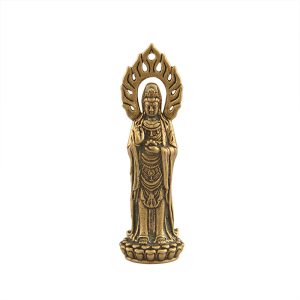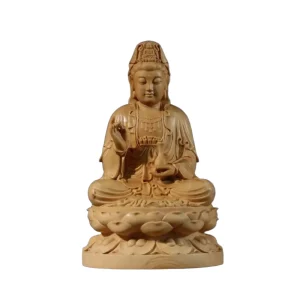
Walk into any sanctuary of peace—from the ancient, incense-swirled temples of Mount Putuo where the East China Sea mist clings to sandalwood pillars, to a sun-drenched yoga studio in California—and you will encounter her.
But to the discerning eye, she is more than just a calming aesthetic. Whether captured in a translucent piece of “Blanc de Chine” or a weathered stone carving, the Goddess Quan Yin (standardized in Pinyin as Guanyin) represents a radical defiance of power. Before she was a deity, legend tells us she was Miao Shan—a woman who said “no” to an empire to say “yes” to humanity.
This is the story of that transformation, and why a statue of Quan Yin remains one of the most complex symbols in Eastern spirituality.
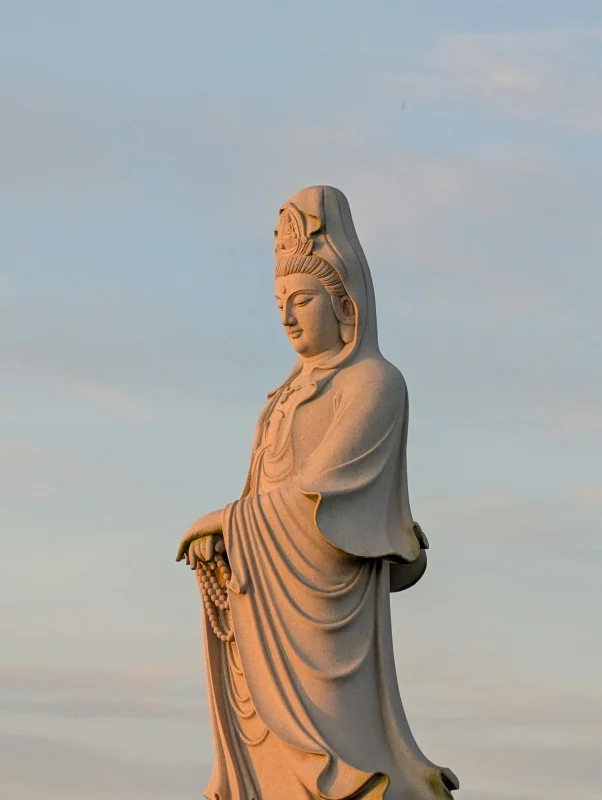
The Great Transformation: From Prince to Princess
To understand the Quan Yin meaning, one must first navigate a fascinating theological shift that often confuses Western collectors.
In early Indian Buddhism, the Bodhisattva of Compassion was Avalokiteshvara, depicted in Gandharan art as a mustachioed male prince. How did this masculine figure evolve into the graceful female deity we know today?
Scholars point to the Buddhist concept of Upaya, or “skillful means.” The idea is that a Bodhisattva appears in whatever form is necessary to liberate beings. As Buddhism took root in China, the culture yearned for a maternal archetype—a source of unconditional forgiveness that fierce, warrior-like deities could not provide. The story of Princess Miao Shan became the vessel for this evolution, softening the deity’s features and merging the Indian concept of compassion with the Chinese virtue of filial piety.
The Rebel in the Palace
The legend places us in the Zhou Dynasty, within the court of King Miao Zhuang.
The King’s palace was a place of rigid order and iron will. To him, his third daughter’s obsession with Buddhist sutras wasn’t just a quirk—it was a political betrayal. While her sisters wore their marriage alliances like jewelry, Miao Shan sought a “wedding” to the liberation of all sentient beings.
The conflict was visceral. When she refused the King’s command to marry, his punishment was designed to crush her spirit through the sheer weight of physical reality. He exiled her to the gardens, stripping her of royal status and forcing her to haul water and scrub floors until her hands bled.
But folklore thrives on the miraculous. It is said that when the princess labored, the natural world rebelled on her behalf. The wells rose to meet her bucket; the birds collected firewood. This harmony with nature is often depicted in Quan Yin images, where the goddess sits at ease in a wild grotto, untouched by the chaos around her.
Fire, Hell, and the “One Without Anger”
When labor failed to break her, the King turned to violence. He ordered the burning of the White Sparrow Monastery where she sought refuge. As flames consumed the timber, Miao Shan pricked her finger with a bamboo needle. A single drop of blood fell, summoning a rainstorm that extinguished the inferno.
Humiliated, the King ordered her execution.
The narrative here breaks the boundaries of the mortal world. Miao Shan’s soul descended into Diyu (Hell). But a being of pure compassion cannot exist in a place of torment without changing it. Her very presence turned instruments of torture into lotus flowers. The Lords of Hell, fearing their realm would become a paradise and lose its function, quickly released her.
She was restored to life on Fragrant Mountain (Xiangshan), deepening her cultivation until she achieved enlightenment.
Years later, the King fell victim to a mysterious, rotting disease. His physicians were helpless. A monk appeared, whispering of a cure that required a terrible price: a medicine brewed from the eyes and hands of one “without anger.”
Desperate, the King sent envoys to the ascetic of Fragrant Mountain.
Miao Shan did not hesitate. She did not demand an apology. She gouged out her eyes and severed her hands, offering them on a platter to save the father who had tried to kill her.
The Thousand-Hand Revelation
The King recovered. Overcome with gratitude, he made a pilgrimage to thank his savior, only to find his daughter maimed and bleeding in a cave.
The shock broke him. He fell to the ground, weeping in repentance.
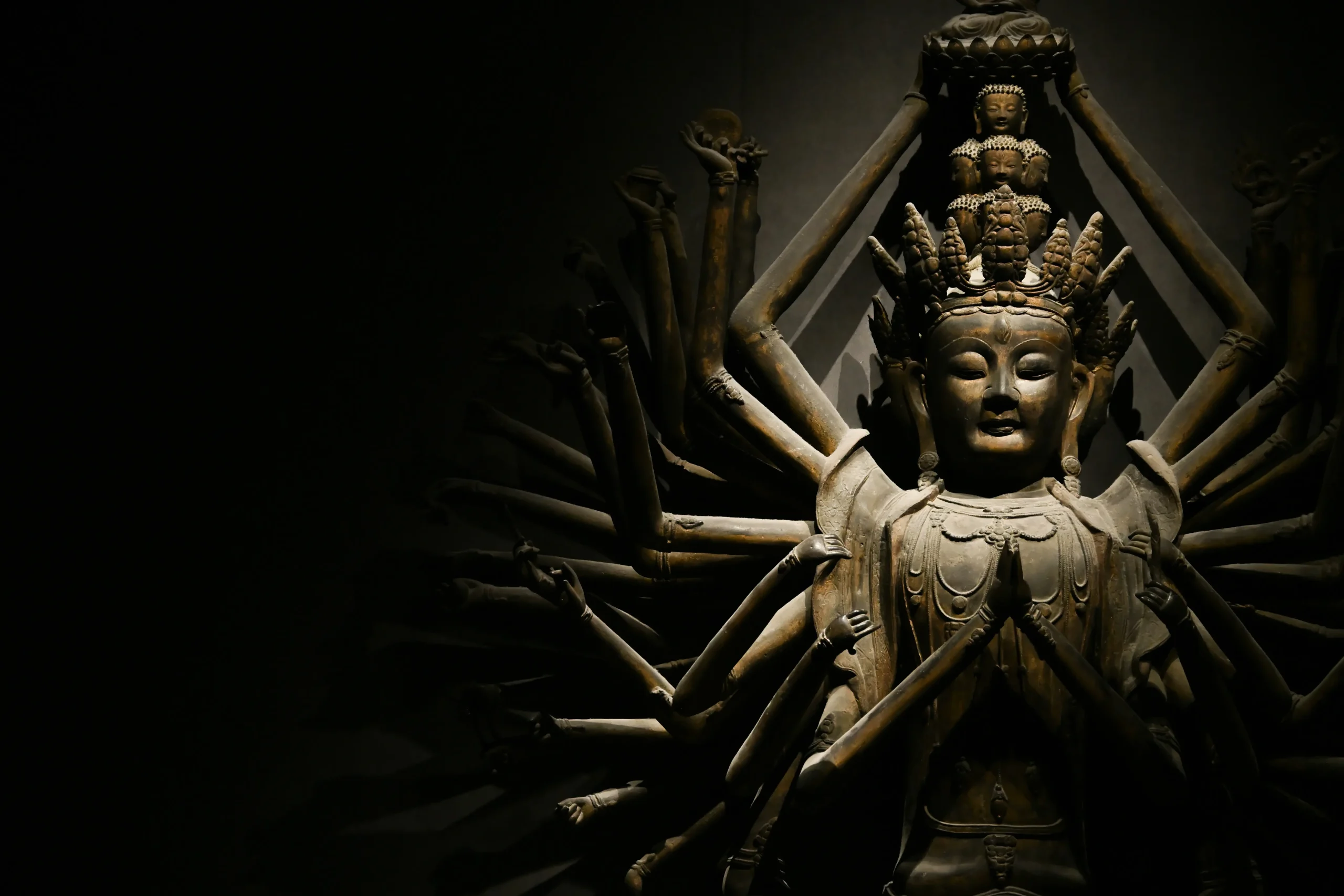
It was in this moment of total reconciliation that Miao Shan transcended her human form. She was not just restored; she was amplified. She appeared in a blaze of golden light, manifesting a thousand eyes to see all suffering, and a thousand hands to aid those in need.
She had fully become the Quan Yin Goddess of Mercy.
A Collector’s Guide: Reading the Iconography
For the Western buyer, navigating the market of Quan Yin art can be daunting. Authenticity isn’t just about age; it’s about the lineage of the craftsmanship and the intent of the material.
The Dehua Standard (Porcelain)
If you are looking for a porcelain Quan Yin, the gold standard is Dehua ware. Known in the West as Blanc de Chine, this style originates from Fujian province. Its distinctive creamy-white glaze mimics the translucency of a pure soul. A genuine Dehua piece does not rely on colorful paint; it relies on shadow and light playing across the intricate folds of the robes. It is ideal for a quiet, indoor altar.
Jade as a Talisman
When choosing a Quan Yin jade pendant, look for “serenity in the carving.” In Chinese tradition, jade is more than a stone; it is an energetic shield. There is a persistent belief that if your jade pendant breaks, it has absorbed a blow meant for you—a direct echo of Miao Shan’s own sacrifice. Wearing a Quan Yin necklace is often seen as a way to keep compassion close to the heart chakra.
The Dragon and the Garden
You will often see the Quan Yin and dragon motif. This is not a “slaying” of the dragon, but a taming. It represents the mastery of wisdom over chaotic elements. These statues, often cast in bronze or carved from granite, make for a powerful large Quan Yin garden statue. Placed near water features, they ground the energy of a home, reminding us that patience is stronger than force.
The Sound of Mercy
Visuals are only half the practice. The Quan Yin mantra—Om Mani Padme Hum—is frequently chanted by those who keep her image. It is the sonic representation of her vow: to wait until every blade of grass has entered enlightenment before she herself rests.
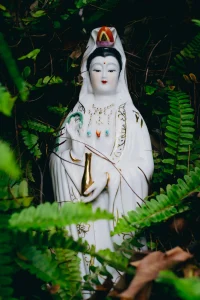
The Ambiguity of Legend
Scholars continue to debate the timeline. While the story is set in the Zhou Dynasty, textual evidence of the Miao Shan legend solidifies much later, around the Song Dynasty.
But perhaps this historical ambiguity is the point.
Whether you view her through the lens of a Quan Yin goddess of mercy statue in a museum, or a simple Quan Yin pendant worn for protection, her relevance remains untouched by time. The legend of Miao Shan asks a difficult question of us: Can we offer a hand to those who have hurt us?
In the end, Quan Yin is not a passive idol. She is a challenge. She challenges us to act with a love that is fierce, unconditional, and, when necessary, revolutionary.